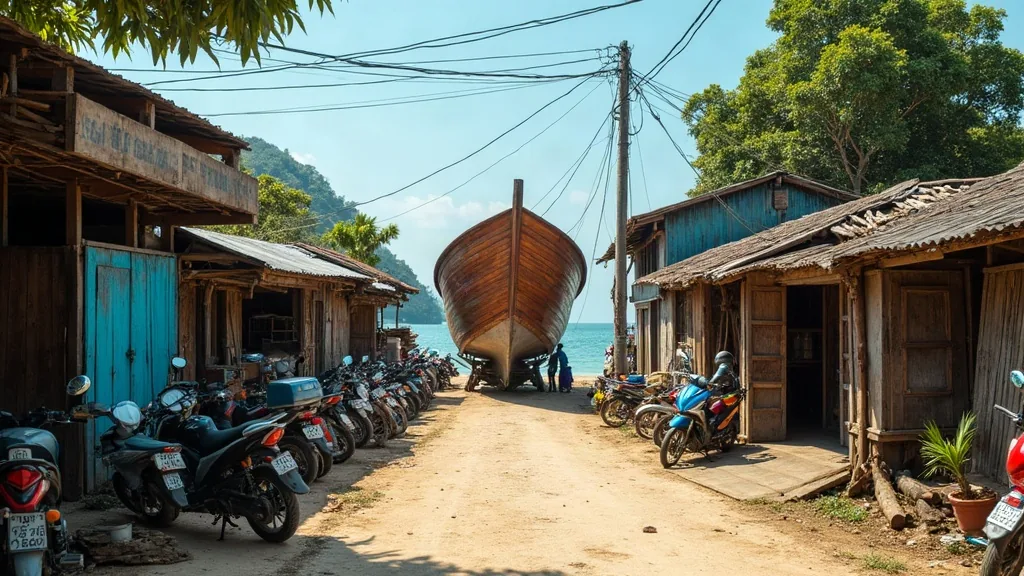
Nobody sells admission to Tana Beru. Travel write-ups translate that into “free entry”, which is technically true and practically misleading. There is no ticket booth because the question of admission was never formalised — this is a village shoreline where people work, not an attraction that decided to waive its fee. Four things follow from that, and three of them affect you directly.
The distinction that matters
A free attraction has an operator who has chosen not to charge. There is still someone running it: someone who decides opening hours, marks a walkway, puts up a sign, carries liability insurance and employs a person whose job includes telling you not to stand there.
Tana Beru has none of that, because there is no operator at all. It is not one shipyard. It is a stretch of coast where independent crews build hulls for different customers, each under its own master shipwright. There is no head office, no gate and no admissions policy — and therefore nothing to waive. That structural fact is set out on the about page and it explains almost everything else visitors find surprising.
Consequence one: nobody is responsible for your safety
This is the one that matters most and gets mentioned least. There is no marshal, no barrier tape, no hard-hat rule and no insurance covering visitors. Hulls weighing many tonnes stand on timber shores. Offcuts, nails and dowel ends are in the sand. People swing adzes. Ropes are laid out for hauling, and when they move they move fast.
None of that makes the yard dangerous to a careful adult. It makes it a place where care is entirely your own job. Closed shoes, distance from shored hulls, and never stepping inside a run of rope are the three rules that cover most of the risk — the full list is in the visiting guide.
Consequence two: there are no facilities, because there is no budget for them
No toilets for visitors, no shade structures, no interpretation boards, no guide desk, no car park, no bins. The warung along the road sell water and food, and that is the extent of visitor infrastructure. Arrive self-sufficient: water, sun protection, cash in small notes, and no expectation of anywhere to sit.
Consequence three: nobody is obliged to let you look
Free access is not a right that has been granted; it is a courtesy that has never been withdrawn. Each hull belongs to a customer and each crew has work to finish on a schedule someone is paying for. Visitors are tolerated — usually warmly — because they have historically been unobtrusive.
That courtesy is renewable and it is also exhaustible. Crews that get climbed on, photographed in the face without a word, filmed by drone with no warning, or interrupted by a group wanting a demonstration will start saying no. The etiquette in the visiting guide is not politeness for its own sake; it is the maintenance of an arrangement that costs you nothing and costs them time.
Consequence four: money still has a place, just not at a gate
“No entrance fee” leads some visitors to conclude that no money should change hands at all. That is not quite right either. Reasonable and normal: buying water and food from the warung, paying an ojek properly, tipping a young person who spends an hour walking you along the beach and explaining what you are looking at, paying a driver to wait. Not normal: attempting to pay a crew for access to a hull, or handing out money to children.
If your visit is commercial — filming, a production shoot, a client inspection — then the calculus changes completely and payment for arranged access, interruption or crew time is appropriate. That is covered on the photography and filming page.
Why this is better than the alternative
It is worth saying plainly: the absence of a ticket booth is the reason Tana Beru is worth visiting. What you see is a working yard behaving exactly as it would if you were not there. Crews are not performing. No hull was placed for the view. The sequence you walk past — bare keel, half-planked shell, framed hull, faired and primed vessel — is real production, not a display, which is why a morning’s walk teaches you more about wooden shipbuilding than most museums.
Formalise it and you would get a car park, a boardwalk, a viewing platform, a fee, and hulls arranged for photographs. Several places in Indonesia have gone that way. Tana Beru has not, and the informality that visitors sometimes read as neglect is the same informality that keeps it authentic.
The short version
Free entry means: no one is charging you, no one is protecting you, no one is obliged to host you, and nothing is arranged for you. Behave accordingly and you will be welcome. For the rest of the practicalities, the access page covers routes and the village comparison covers where to base yourself.
Frequently asked questions
Is there really no entrance fee at Tana Beru?
No official ticket booth or gate fee is in place. That is because there is no single operator running the site rather than because an operator has chosen to waive a charge — Tana Beru is a village shoreline where independent crews build hulls for different customers.
Does free entry mean it is safe to walk anywhere?
No. There is no marshal, no barrier, no marked walkway and no insurance covering visitors. Hulls stand on timber shores, ropes are laid for hauling and offcuts and nails are in the sand. Care is entirely your own responsibility.
Are there toilets or facilities for visitors?
No. There are warung along the road selling water and food, and that is the extent of it. There is no visitor centre, no toilets provided for tourists, no shade structures and no car park.
Should I pay anyone anything?
Buying from the warung, paying an ojek or driver properly and tipping someone who spends real time guiding you are all normal. Attempting to pay a crew for access to a hull, or handing money to children, is not.
Could access ever be restricted?
Yes. Access is a courtesy rather than a right, extended because visitors have historically been unobtrusive. Crews who are climbed on, photographed without a word or interrupted repeatedly will start refusing, which is why etiquette matters.