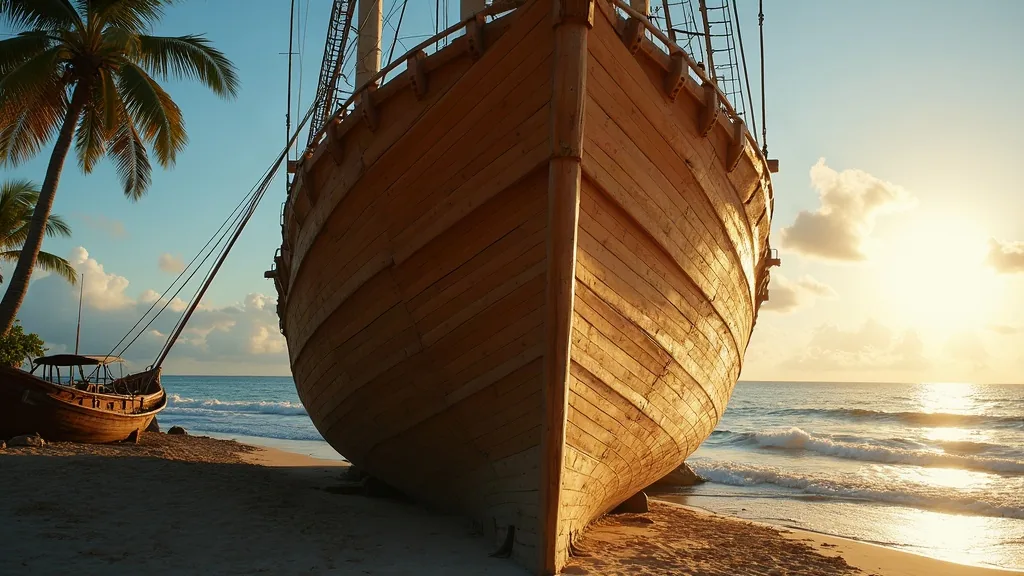
Personal photography at Tana Beru needs no permit and no ticket — you are on an open working shoreline. Commercial filming, drone flight and anything involving recognisable people is a different matter, and is best arranged rather than assumed. Light rakes along the hulls in the first two hours after sunrise and the last hour before sunset.
Light: when to be standing there
The hulls sit along a shoreline, so the sun tracks across them rather than down them for much of the day. Early morning light rakes along the planking and picks out the adze marks, the dowel ends and the curve of the strakes — the texture that makes these photographs worth taking. Midday sun flattens all of it and blows out the sand.
Late afternoon gives the other classic frame: the hull backlit against the sea, scaffolding in silhouette, dust and haze catching the light. Morning is better for detail and for activity, because that is when crews work; evening is better for shape and atmosphere. The photography field guide goes further into lens choice and framing.
What you can photograph freely
- The vessels, at any stage of construction
- Timber, tools, scaffolding and the yard environment
- Wide scenes including people at a distance, going about work
- The shoreline, the village and the sea
What needs a word first
- Close portraits and recognisable faces. Greet, gesture at the camera, wait for the nod. It is almost always given, and asking is the entire difference between being welcome and being resented.
- Working inside or on a hull. That vessel belongs to a customer and the scaffolding belongs to the crew. Ask before climbing anything.
- Ceremonies. Keel blessings and launches are ritual, not spectacle. Stand back, ask, and accept a no — see the ceremonies page.
- Children. Ask a parent, or do not take the frame.
Drones
Drone footage of the shoreline is the reason many production crews come, and it is also where most of the friction occurs. Two separate questions apply. The first is regulatory: Indonesian civil aviation rules govern drone operation, and requirements vary with weight, altitude and airspace — that is a matter for the operator to confirm before travelling, not something the village grants. The second is social: a drone over a working yard is intrusive, noisy and hazardous to people working under it, and flying without telling anyone is the fastest way to have the whole village turn against a shoot.
The practical approach is to make contact in advance, fly at times agreed with the crews, and never hover over people or a hull being moved.
Commercial filming and stills production
If the output is commercial — broadcast, advertising, stock, a brand campaign — treat this as a production location rather than a public beach. That means arranged access, an agreed shooting window, someone on the ground who can speak with the crews, agreed compensation where a crew’s work is interrupted or directed, and clarity about which vessels can appear on camera. A hull under construction is a customer’s property, and its owner may not want it identifiable before launch.
Handled that way, Tana Beru is an exceptionally generous location. Handled as a free-for-all, it becomes a place where the next crew is told no. Production enquiries go through the contact desk.
Practical kit notes
- Wide and short telephoto together. A wide for the hull in its setting, a short telephoto to compress the row of vessels along the shore and to take detail without standing on top of someone.
- Dust protection. Sawdust and fine sand are constant. Change lenses as little as possible.
- Closed shoes. Nails, dowel ends and offcuts are everywhere in the sand, as noted in the visiting guide.
- Shade for gear. There is almost none once you leave the workshop shelters.
Note on imagery used on this site: illustrative images on these pages are AI-generated and are not documentary photographs of specific vessels, crews or events at Tana Beru.
Frequently asked questions
Do I need a permit to photograph at Tana Beru?
Not for personal photography. It is an open working shoreline with no ticket booth or gate. Commercial filming, stills production and drone operation should be arranged in advance rather than assumed.
When is the light best for photography?
The first two hours after sunrise and the last hour before sunset. Morning light rakes along the planking and shows texture while crews are working; late afternoon gives backlit silhouettes of the hulls against the sea.
Can I fly a drone over the yard?
Only after confirming Indonesian civil aviation requirements for your aircraft and flight, and after telling the crews working below. Never hover over people or over a hull being moved.
Is it acceptable to photograph the workers?
Wide scenes with people at a distance are normally fine. For close portraits and recognisable faces, greet the person and gesture at the camera first. Permission is usually given, and asking is what keeps it that way.
Can I photograph any vessel under construction?
For personal photography, generally yes. For commercial output, no — a hull under construction is a customer’s property and the owner may not want it identifiable before launch, so appearing vessels should be agreed in advance.
Discuss this with the Tana Beru Shipyard Build Desk
WhatsApp +6281139414563 · bd@juaraholding.com
Contracts in this service class are issued by PT Komodo Galangan Nusantara. Quotations in USD.