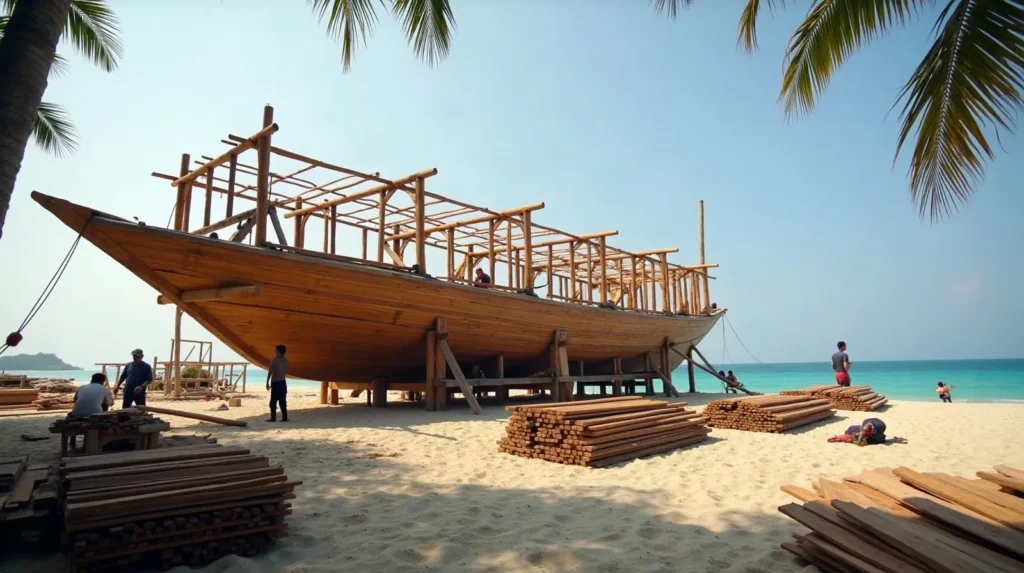
There is no single price for a phinisi. A bare working hull costs a fraction of a fitted charter yacht of the same length, and budgets at Tana Beru are quoted in USD per project after a brief — not from a price list. This page explains what actually moves the number.
Ask three people what a phinisi costs and you will get three answers, all of them true for the boat that person bought. A cargo hull ordered by a Sulawesi trading family, an owner’s liveaboard shell delivered ready for fit-out elsewhere, and a turnkey charter yacht certified for paying guests are three different projects that happen to share a hull form. Before comparing numbers, decide which of the three you are actually buying. The build sequence those budgets pay for is laid out step by step on the build timeline page.
What drives the price
Length and displacement — cost per metre is non-linear
A 35-metre hull is not simply forty per cent more expensive than a 25-metre hull. Displacement rises much faster than length, and with it the volume of structural timber, the size of every frame and floor, the crew needed to move members into place, and the months on the sand. Doubling internal volume can more than double structural cost. This is why serious enquiries start from length and intended use, never length alone.
Timber grade and sourcing distance
Timber is the single largest materials line. Dense structural woods — bitti for frames, ironwood for the keel and underwater structure, teak for decks — vary in price with grade, girth and how far they must travel to reach Bulukumba. Long, clear lengths for keels and sheer strakes carry a premium, and the market moves year to year, which is one reason a written quote has a validity window. What each species does in the hull, and what owners should demand as sourcing evidence, is covered on the timber and materials page.
Bare hull versus turnkey charter fit-out
The hull is the famous part of the project but not, on a yacht, the most expensive one. Interiors, glazing, tankage, wiring, plumbing, refrigeration, navigation electronics, safety equipment, rig and sails, tenders and davits can together exceed the cost of the woodwork beneath them. A shell delivered caulked and decked is one budget; the same vessel sleeping twelve guests with certified systems is a different budget multiple times larger.
Class, flag and certification scope
A private boat and a commercial passenger vessel answer to different paperwork. Class survey attendance during the build, certified materials, safety and stability documentation, and commercial registration all add real cost — some of it in professional fees, some in the heavier construction the surveyor expects to see. The government’s own charges, such as registration and harbourmaster fees, are payable in IDR at published rates and are itemised separately in any honest budget.
Design and supervision services
Drawings, specification writing and independent owner-side supervision are the smallest of the five drivers and the cheapest insurance in the project. A clear materials specification prevents the expensive ambiguity of “good wood, normal size”, and scheduled inspections tied to stage payments keep the budget attached to physical progress. How that works in practice is described on the supervision page.
Budget bands by project type
Working cargo hull
The entry point of the market: a strong, plainly finished hull with a basic deckhouse, built to carry goods, not guests. Machinery is simple, interiors are minimal, certification is domestic. This is the class of boat the yards have always built for trade, and it remains the least expensive way to own a Tana Beru hull.
Owner’s liveaboard, conversion-ready
The middle band: a hull built with a yacht’s scantlings and layout in mind, delivered structurally complete for fit-out at the beach or elsewhere. Owners choose this band to control the interior phase themselves — sometimes to spread cost over seasons, sometimes to use joinery teams of their own choosing. The hull budget sits above cargo grade because timber selection and fairness of finish are held to a higher standard.
Turnkey charter yacht
The top band, and the widest one: everything from a modest dive boat to the large custom yachts that took twenty months or more on the sand. Here the fit-out, systems and certification dominate the number, and the realistic budget conversation is about guest count, class scope and finish level rather than the hull itself. Most owners in this band pair the build with the full commissioning framework described on the commission-a-build page.
How payment actually flows
Mobilisation and timber purchase
The first instalment exists to buy wood. Keel and structural timber must be secured early — sometimes months before the keel is laid — so the opening payment is sized to the timber schedule, not to a round percentage. It is the one payment made against a plan rather than against visible progress, which is exactly why the timber receipts belong in the owner’s file.
Stage payments against milestones
After mobilisation, money follows the boat: keel laid, frames up, planking closed, decks on, superstructure complete, systems in, launch. Each release is tied to a physical state that can be photographed, measured and signed off. A contract written this way protects both sides — the crew is never working unpaid, and the owner is never paying for work that does not yet exist.
Ceremony and launch costs
The ceremonies inside a build — keel-laying, the ammossi before launch, and the launch feast — are traditionally sponsored by the owner. They are modest local costs, paid in IDR at local rates, and they are not incidental: they are part of how a hull and its crew are bound to the village that built it. Budget for them deliberately rather than discovering them.
What is never paid up-front
The full contract value, or anything close to it. No legitimate Tana Beru build asks for the majority of the money before the majority of the boat exists. A request for a dominant up-front payment is not how the stage-payment culture works here, and it is the clearest warning sign an enquiry can meet.
Costs owners forget
The delivery voyage
A finished hull at Tana Beru is not yet a boat in Komodo, Raja Ampat or Bali. Crew, fuel, provisioning and insurance for the delivery voyage belong in the project budget from day one, because they arrive at the exact moment most owners feel the spending should be over.
Registration and government fees
Registration, tonnage and harbourmaster paperwork carry official fees payable in IDR. They are small next to the build itself but they gate the boat’s legal life, and commercial operation adds its own certification layer on top.
First-year maintenance reality
A new wooden hull moves, settles and tightens through its first year. Re-caulking a seam, adjusting a rig and renewing antifouling are normal first-year work, not defects. Owners who budget a first-year maintenance line treat it calmly; owners who do not, call it a crisis.
Get a real number
Send your intended length, use — liveaboard, charter, private or cargo — and target season to the desk, and you will receive a written USD budget frame tied to the current timber market. There is deliberately no generic price list, because the timber market moves and honest numbers date quickly. Reach the desk directly through the contact page or on WhatsApp below.
Frequently asked questions
How much does a phinisi cost to build?
Budgets are quoted in USD per project. A bare working hull is the entry point; a fully fitted charter yacht of the same length can cost several times more once interiors, systems and certification are included.
Why is there no public price list?
Timber cost, hull size, finish level and certification scope vary so widely that a list would mislead. The desk issues a written USD budget frame after a short brief instead.
What deposit is required?
Builds run on stage payments, not large deposits: a mobilisation instalment covers timber purchase, then payments release against physical milestones verified on site.
Are there hidden costs?
The usual surprises are the delivery voyage, government registration fees (payable in IDR), ceremony sponsorship and first-year maintenance. All four are itemised in the desk’s budget frame.
Is building at Tana Beru cheaper than buying a used phinisi?
Not always. A newbuild buys exact specification and known timber history; a used hull can be faster and cheaper up-front but carries survey risk. The desk can frame both paths.
Discuss this with the Tana Beru Shipyard Build Desk
WhatsApp +6281139414563 · bd@juaraholding.com
Contracts in this service class are issued by PT Komodo Galangan Nusantara. Quotations in USD.