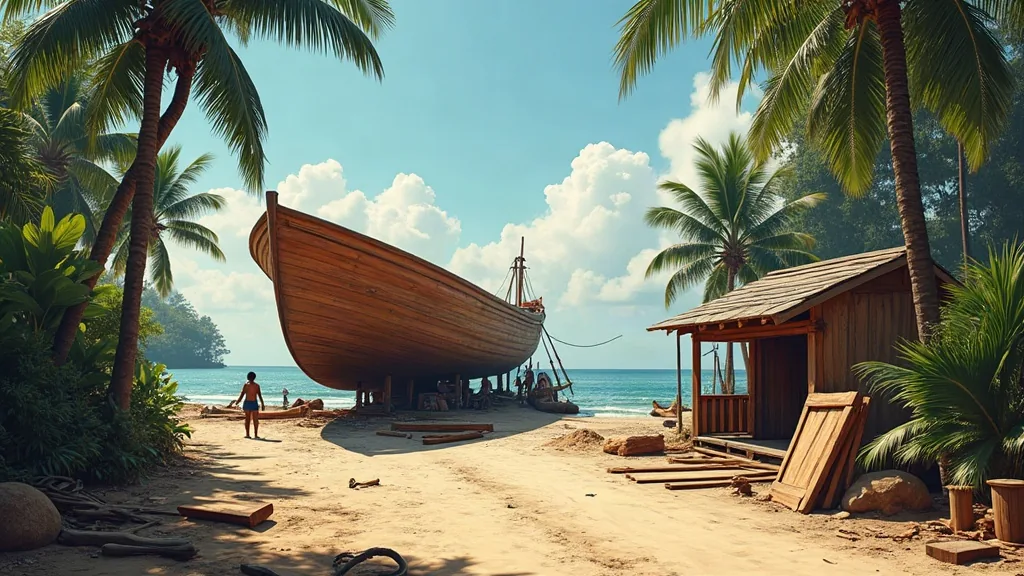
You can visit Tana Beru freely. There is no gate, no ticket office and no published opening hours — the yard is an open stretch of village shoreline where crews work in the open air, generally between about 08:00 and 17:00. Arrive in the morning, stay out of the working lines, and ask before you photograph a person.
What “open” really means here
Tana Beru is not managed as a tourist site. Nobody sells admission, nobody runs a schedule, and nobody is on duty to keep visitors safe. The village road runs along the back of the yard and the hulls stand between that road and the sea, so in practice you simply park and walk. The absence of a ticket booth is often reported as “free entry”, but it is more accurate to say the question of entry has never been formalised. We unpack that distinction in the piece on what free entry really means.
The consequence matters: because there is no operator, there is also no safety marshal, no marked walkway and no insurance. Treat it exactly as you would treat walking onto a construction site by invitation.
Best time to arrive
Morning, without much argument. Crews are most active in the first hours of the day, before the heat builds. The light in the morning also runs along the length of the hulls rather than down onto them, which is what photographers want. By early afternoon many crews break, and the beach can be quiet enough that a visitor sees timber but no work.
Weekdays are more active than Fridays, when work often pauses around midday prayers. There is no seasonal closure — the yard works year-round — but the rainy months slow outdoor tasks such as caulking and painting.
What you will actually see
Expect several hulls at once, each at a different stage. On any given visit you might see a keel and stem newly laid on blocks, a hull half-planked with its shell curving into shape, a fully planked vessel with the deckhouse being framed, and — if the timing is lucky — a finished hull being prepared to move to the water. The variety is the point: one walk along the beach shows you the entire sequence described in the build timeline.
You will also see the tools. Adzes, hand planes, augers, chainsaws for rough conversion, and wooden mallets. What you will rarely see is a drawing. The shape is held by the master shipwright, which is the subject of the Konjo method page.
Etiquette that local crews actually notice
- Greet before you shoot. A short greeting and a gesture toward the camera is enough. Most crews are relaxed about photography of the vessel; faces are a different matter.
- Do not climb on a hull unless someone working on it invites you. Scaffolding is built for the crew’s weight and habits, not a visitor’s.
- Stay off the hauling lines. If ropes are laid out across the sand, something is about to move.
- Do not take offcuts as souvenirs. Timber is expensive and the pieces on the ground are usually spoken for.
- Dress for a worksite. Closed shoes, not sandals — the sand around a hull is full of nails, dowel ends and splinters.
Practicalities
There are warung and small shops along the road for water and food, but no visitor centre, no toilets provided for tourists and no guide desk. Bring water, cash in small denominations, and sun protection — the beach has almost no shade once you leave the workshop shelters. Most travellers combine the visit with Tanjung Bira, which is around 12 km away; the comparison of Tana Beru, Bira and Ara explains which village suits which interest.
Visiting with a commercial purpose
Casual visiting and commercial visiting are different things. If you are inspecting a hull you are paying for, evaluating a yard before commissioning, or filming for broadcast, an arranged visit is more useful than an unannounced one — someone can meet you, identify which crews are relevant, and get you access to the vessel rather than the beach around it. That is handled through newbuild supervision for owners and the filming page for production crews.
Frequently asked questions
Do I need a ticket or a permit to visit Tana Beru?
No official ticket booth or gate fee is in place, and no permit is required for ordinary visiting and personal photography. Commercial filming and drone work are treated differently and are best arranged in advance.
What are the opening hours?
There are none, because the yard is not run as an attraction. Crews generally work from about 08:00 to 17:00, and the site is most active in the morning.
Is it safe to walk around the hulls?
It is safe if you behave as you would on a construction site. Wear closed shoes, keep away from ropes laid across the sand, do not stand under a hull being propped or moved, and do not climb scaffolding uninvited.
Do I need a guide?
Not for access. A guide or an arranged escort is genuinely useful if you want to understand what stage each hull is at, or if you are visiting with a commercial purpose such as inspecting a vessel you have commissioned.
Can I visit on a day trip from Tanjung Bira?
Yes. Tana Beru is around 12 km from Bira, roughly 20 minutes by road, which makes a morning visit and a return to Bira for the afternoon a common pattern.