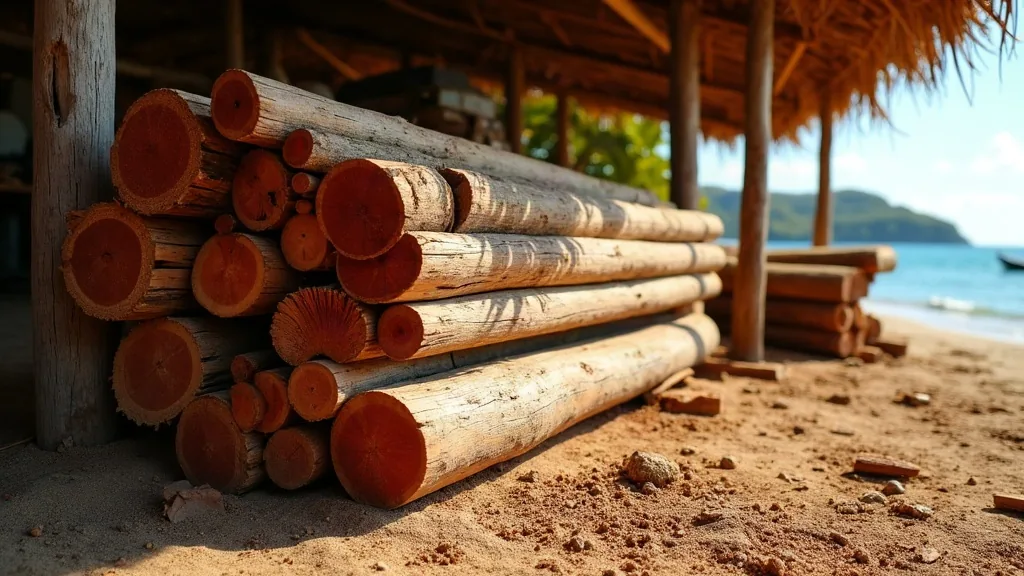
Hulls at Tana Beru are built from heavy tropical hardwoods. Bitti and ironwood — kayu besi — are the usual structural choices for keel, frames and planking, with teak used for decking and joinery. The planks are fastened to each other with wooden dowels rather than nails. Timber availability, seasoning time and legality documentation are now the biggest single constraint on any build here.
The main timbers and what they are for
| Timber | Local name | Typical use | Why it is chosen |
|---|---|---|---|
| Ironwood | kayu besi / ulin | Keel, stem, sternpost, high-load members | Extreme density, very high rot and borer resistance, long service life in salt water |
| Bitti | bitti | Frames, planking, structural timbers | Strong, durable, workable in the long lengths a hull needs, locally established for this use |
| Teak | jati | Decking, joinery, interior fit-out | Natural oils, dimensional stability, holds a finish, comfortable underfoot |
Species selection is not decoration. The keel and the garboard live permanently wet and are the members you cannot replace without effectively rebuilding the vessel, which is why the densest timber goes there. Planking above the waterline can accept a slightly lighter species. A hull specified with the wrong species in the wrong place will look identical on launch day and will show the difference in year seven.
Seasoning is a schedule item, not a detail
Green hardwood cannot be built into a hull that will hold its shape. Timber has to be converted and dried before it is worked, and heavy tropical species dry slowly. If seasoned stock is on hand when a contract is signed, the build starts. If the timber has to be found and dried from green, months pass before anything visible happens on the beach — and the owner, watching an empty patch of sand, concludes the yard has not started.
This is the most common single reason a programme looks late in its first quarter. The honest way to handle it is to make timber availability an explicit precondition in the contract rather than an assumption: species, quantity, dimensions, and whether the stock is already seasoned at signature. The build timeline places seasoning where it actually belongs — usually before the clock starts.
Legality and documentation
Indonesia operates a timber legality assurance system, and legally sourced timber carries documentation through the supply chain. For a vessel that will be registered, insured, classed or chartered to international guests, undocumented timber is a genuine commercial risk rather than a paperwork nuisance — it surfaces at registration, at insurance underwriting and increasingly in charter due diligence.
The practical position for an owner is straightforward: require documented, legally sourced timber in the contract, ask for the chain of documents at each delivery of stock, and retain copies with the build record. It costs more and it takes longer. The alternative costs more later. Where timber sits inside the overall budget is set out in the phinisi cost guide. The wider supply picture — including the parts of it that are genuinely uncomfortable — is set out in the wood question.
How timber choice shows up in hull life
A well-built hardwood hull, hauled and maintained on a proper cycle, has a long working life; a hull built from unseasoned or poorly chosen timber begins showing seam problems, plank movement and localised rot within a few seasons. The variable is not mainly the yard’s skill — it is the wood and the maintenance regime. How long a wooden hull actually lasts looks at the evidence.
What to write into a specification
- Species by structural member — keel, stem, frames, planking, decking, joinery
- Scantlings: plank thickness, frame siding and moulding, spacing
- Seasoning state at contract signature, and who carries the cost of waiting
- Fastening type and dowel material
- Legality documentation to be supplied with each timber delivery
- Rejection rights for stock delivered outside specification
Those clauses are the ones that get argued about later if they are missing. Commissioning a build sets out how they sit within the contract, and newbuild supervision covers who inspects the timber on delivery. Contracts in this service class are issued by PT Komodo Galangan Nusantara, with values stated in USD.
Where a build runs from proper drawings, the timber schedule is where those drawings first meet reality: scantlings, species and seasoning states all have to be written down against each member. A naval-architecture and interior design studio can produce that schedule as part of the design package, which gives the owner and the crew the same document to build and inspect against.
Frequently asked questions
What wood is a phinisi made from?
Heavy tropical hardwoods. Ironwood (kayu besi or ulin) is used for the keel, stem and high-load members, bitti for frames and planking, and teak for decking, joinery and interior fit-out.
Why are the planks fastened with wooden dowels?
Wooden dowels swell and move with the same moisture as the planks they join, so the joint stays tight. Iron fastenings corrode in a permanently wet hull and split the timber around them.
How long does the timber need to be seasoned?
Long enough that it is dry and stable before it is worked — heavy tropical hardwoods dry slowly. The practical question for an owner is whether seasoned stock is already available at contract signature, because sourcing and drying from green adds months before visible work begins.
Does the timber need legality documentation?
For any vessel that will be registered, insured, classed or chartered to international guests, yes. Require documented, legally sourced timber in the contract and retain the chain of documents with the build record.
Does timber choice affect how long the hull lasts?
Substantially. Species selection at the keel and garboard, and whether the timber was properly seasoned, are among the strongest predictors of whether a hull runs for decades or develops seam and rot problems within a few seasons.