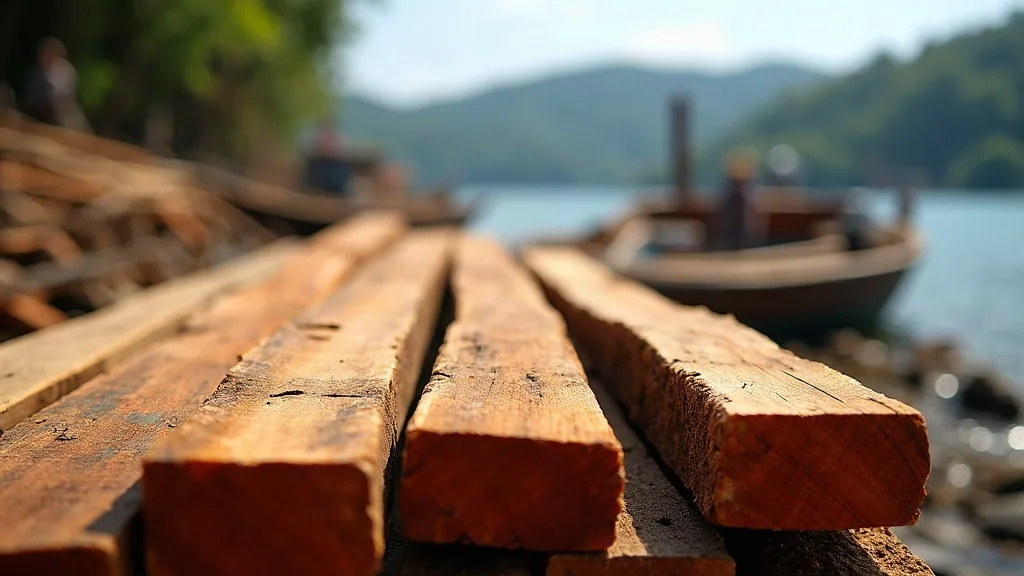
A wooden hull needs dense, durable, rot-resistant hardwood in long clear lengths. Ironwood and bitti do that job better than almost anything else, which is precisely the problem: slow-growing, heavy, high-value species under pressure everywhere they occur. This is the constraint that will shape the next twenty years at Tana Beru, and it is the part of the story that publicity writing about heritage shipbuilding usually skips.
Why these species and not others
The requirements are unforgiving. A hull plank must be dimensionally stable, resistant to marine borers and fungal decay, strong enough to act as structure rather than skin, workable by hand, and available in long lengths without knots. Ironwood — kayu besi or ulin — meets that specification about as well as any timber on earth, which is why it goes into keels, stems and the members you cannot replace. Bitti carries frames and planking. Teak handles decking and joinery, where its oils and stability matter more than raw density. The timber page sets out the allocation by structural member.
The qualities that make these timbers right are the same qualities that make them scarce. Density and durability come from slow growth. Slow growth means a tree that took a very long time to reach the size a keel requires, and cannot be replaced on any commercial timescale.
The problem, stated plainly
Demand for large-dimension tropical hardwood is not driven mainly by boatbuilding — construction, furniture and export markets dwarf it. But wooden shipbuilding needs exactly the pieces that are hardest to replace: long, clear, large-section timber from mature trees. A yard cannot substitute three short pieces for one long keel.
The consequences are visible on the beach. Timber that once arrived locally now travels further. Prices have moved in one direction. Crews wait for stock. And a proportion of what circulates in any tropical hardwood market has documentation that would not survive scrutiny.
None of this is unique to Tana Beru, and none of it is a reason to avoid building in wood. It is a reason to build deliberately rather than casually.
Legality documentation is not paperwork
Indonesia operates a timber legality assurance system, and legally sourced timber carries documentation through the supply chain. For a vessel that will be registered, insured, classed or chartered to international guests, that documentation is a commercial asset. Its absence surfaces at registration, at insurance underwriting, and increasingly in charter due diligence conducted by operators and agents who have their own compliance exposure.
An owner who requires documented timber pays more and waits longer. An owner who does not may find the saving reappears as a problem at exactly the moment the vessel is supposed to start earning. Registration and classification covers where this bites.
What to require in a contract
- Species named by structural member — keel, stem, frames, planking, decking, joinery.
- Legality documentation supplied with each delivery, and retained in the build file.
- Inspection and rejection rights at delivery, exercised by your representative rather than assumed — see newbuild supervision.
- Seasoning state declared at signature, with responsibility for waiting time allocated.
- No substitution without written approval. Species substitution is the quiet variance that shows up years later as a soft plank.
The honest options for reducing pressure
Three are real, and each has a cost:
Use less of the scarcest timber. Reserve ironwood for the members where nothing else will do — keel, stem, sternpost — and specify appropriate alternatives elsewhere rather than defaulting to the densest available species throughout. This requires a builder willing to have the conversation and an owner willing to accept a specification that is engineered rather than maximal.
Extend hull life through maintenance. The most effective timber conservation available is not building a second hull. A vessel hauled and maintained on a proper cycle can serve for decades; one neglected between haul-outs needs plank replacement in a handful of years and a replacement hull far sooner. Hull life covers the cycle that determines this.
Repair rather than replace. A refit consumes a fraction of the timber of a new build, and the yard’s plank-replacement competence is genuinely high. Owners weighing a new vessel against restoring an existing one should price both — the answer is not always the new one.
What this does not mean
It does not mean wooden shipbuilding at Tana Beru is illegitimate, or that heritage construction should stop. The craft was inscribed on the UNESCO Representative List of the Intangible Cultural Heritage of Humanity in 2017 precisely because it is worth keeping alive, and a living craft needs vessels being built — see what the inscription changed. A tradition preserved only in museums is a tradition that has ended.
It means the material question deserves the same seriousness as the schedule and the price. An owner who specifies documented timber, uses the scarcest species only where necessary, and maintains the hull properly is doing more for the future of this yard than any amount of admiring writing about heritage.
The short version
Ironwood and bitti are the right timbers and they are getting harder to obtain. Require documentation, specify by member rather than by default, budget for the wait, and then maintain what you build. Commissioning a build sets out how these clauses sit in a contract, with values stated in USD.
Frequently asked questions
What timber is used for wooden vessels at Tana Beru?
Ironwood, known locally as kayu besi or ulin, for keels, stems and high-load members; bitti for frames and planking; and teak for decking, joinery and interior work.
Why is that timber becoming harder to obtain?
The qualities that make these species suitable — density, durability, resistance to marine borers — come from slow growth. Wooden shipbuilding also needs the hardest pieces to replace: long, clear, large-section timber from mature trees, which cannot be substituted with shorter lengths.
Does timber legality documentation actually matter?
Yes, commercially. For any vessel that will be registered, insured, classed or chartered to international guests, missing documentation surfaces at registration, at insurance underwriting and in charter due diligence.
How can an owner reduce the pressure on scarce timber?
Reserve the scarcest species for members where nothing else will do, maintain the hull properly so it lasts decades rather than years, and price a refit of an existing vessel against a new build before assuming a new build is the answer.
Does this mean wooden shipbuilding should stop?
No. The craft was inscribed on the UNESCO Representative List of the Intangible Cultural Heritage of Humanity in 2017 because it is worth keeping alive, and a living craft needs vessels being built. It means the material question deserves the same seriousness as schedule and price.