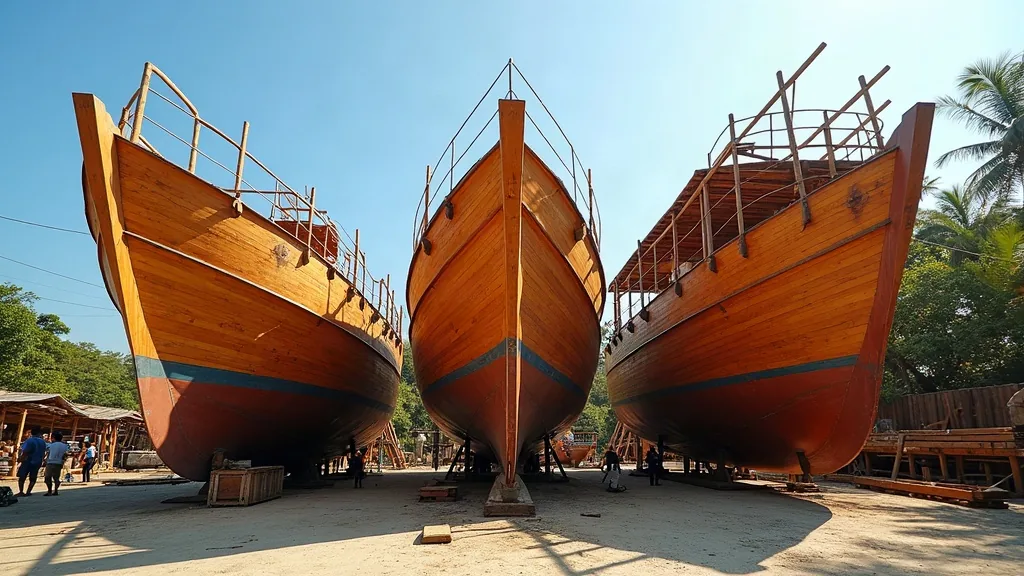
A 30-metre hull at Tana Beru is commonly quoted at nine to twelve months from keel to launch. Smaller craft are often cited at ten to fourteen months, and a large custom yacht with a full interior fit-out at twenty to twenty-four months or more. The spread comes from four things: timber seasoning, crew size, payment rhythm and how much of the fit-out happens on the beach rather than elsewhere.
The stages, in the order they happen
| Stage | What is done | Share of the programme |
|---|---|---|
| 1. Timber procurement and seasoning | Sourcing, converting and drying heavy hardwood; legality documentation | Often before the contract clock starts |
| 2. Keel, stem and sternpost | Backbone laid on blocks; keel-laying blessing | ≈ 5% |
| 3. Shell planking | Strakes shaped and dowelled edge to edge into a self-supporting shell | ≈ 35–40% |
| 4. Internal framing | Frames fitted inside the finished shell; floors and beams | ≈ 15% |
| 5. Deck and superstructure | Deck beams, decking, deckhouse framing | ≈ 15% |
| 6. Caulking, fairing, coatings | Seams sealed, hull faired, primer and antifouling | ≈ 10% |
| 7. Launch | Hull moved down the beach on rollers to the water | Days |
| 8. Machinery and interior fit-out | Engines, systems, cabins, joinery — often at another location | Separate programme |
The single most misunderstood line in that table is the last one. A hull can be “finished” and afloat while the vessel itself is nowhere near complete. Owners who plan a charter season from the launch date rather than from handover are the ones who lose money.
Why the shell comes before the frames
In most Western wooden boatbuilding the frames are erected first and the planking is bent onto them. At Tana Beru the order is inverted: the planks are joined to each other with wooden dowels until the shell holds its own shape, and the frames are fitted afterwards, inside a curve that already exists. This is the defining feature of the Konjo method and it changes the critical path — the hull’s form is committed early and by eye, not late and by drawing. The logic of that sequence is worth understanding before you read a schedule, and the method page covers the technique itself.
The four variables that actually move the date
Timber seasoning
Heavy hardwood must be dried before it is worked or the hull will move after launch. If seasoned stock is available at contract signature, the programme runs. If timber has to be sourced and dried from green, months are added before any visible work begins. This is the most common cause of a build that appears to be “not started” — see the timber page.
Crew size
Work crews at Tana Beru are small and are frequently working more than one hull. A larger crew genuinely compresses the planking stage, which is the longest single block of work. Crew allocation is a contract term worth writing down.
Payment rhythm
Work here is funded stage by stage, and material purchase follows payment. A late stage payment does not delay the build by the length of the delay — it delays it by the length of the delay plus the time to re-mobilise the crew, who will have moved to another hull in the meantime. How stage payments are structured explains the mechanism.
Weather
The structural work continues through the rainy season, but caulking, fairing and coating do not cure properly in sustained wet. A build finishing its coatings in the wettest months will slip.
Milestones you can actually verify
A schedule is only useful if each line can be checked by someone standing on the beach. These are the checkpoints an owner’s representative photographs and signs off:
- Keel, stem and sternpost erected and aligned on blocks
- Garboard strake fitted — the first plank against the keel, and the one that sets the shape
- Turn of the bilge planked — the hardest curve, and the honest halfway mark of the shell
- Sheer strake closed — shell complete
- Frames fitted and fastened throughout
- Deck beams and decking laid
- Caulking complete, hull faired, primer applied
- Launch
Each of those is unambiguous: it is either done or it is not. Vague milestones such as “hull 60% complete” are unverifiable and should not appear in a contract. Newbuild supervision covers who does the checking and what evidence is retained.
Planning backwards from a season
If a vessel must be earning by a particular month, count backwards: sea trials and certification, delivery voyage, interior fit-out, launch, coatings. The delivery voyage alone is a real leg of the programme that owners routinely forget. Working backwards from the revenue date rather than forwards from the keel date is the difference between a schedule and a hope.
Construction and supervision contracts in this service class are issued by PT Komodo Galangan Nusantara, with values stated in USD. Commissioning a build sets out the contract structure. For what those milestones add up to in money, see the phinisi cost guide.
Frequently asked questions
How long does it take to build a phinisi at Tana Beru?
A 30-metre hull is commonly quoted at nine to twelve months from keel to launch. Smaller vessels are often cited at ten to fourteen months, and large custom yachts with a full interior fit-out at twenty to twenty-four months or more.
Does the quoted build time include the interior?
Usually not. The commonly quoted figures cover the hull to launch. Machinery installation and interior fit-out are frequently a separate programme, sometimes carried out at another location after the hull is afloat.
What causes a build to run late?
In order of frequency: timber that has to be sourced and seasoned from green, late stage payments that cause the crew to move to another hull, crew allocation across multiple vessels, and sustained wet weather during caulking and coating.
Which milestones should be written into a contract?
Physical, checkable ones — keel and stem erected, garboard fitted, turn of the bilge planked, sheer strake closed, framing complete, decking laid, caulking and primer complete, launch. Percentage-complete milestones cannot be verified and should be avoided.
Can the schedule be compressed?
To a degree, by having seasoned timber available at signature and by contracting a larger dedicated crew. The planking stage is the longest block of work and is where added crew has real effect. Curing times for caulking and coatings cannot be compressed.
Discuss this with the Tana Beru Shipyard Build Desk
WhatsApp +6281139414563 · bd@juaraholding.com
Contracts in this service class are issued by PT Komodo Galangan Nusantara. Quotations in USD.