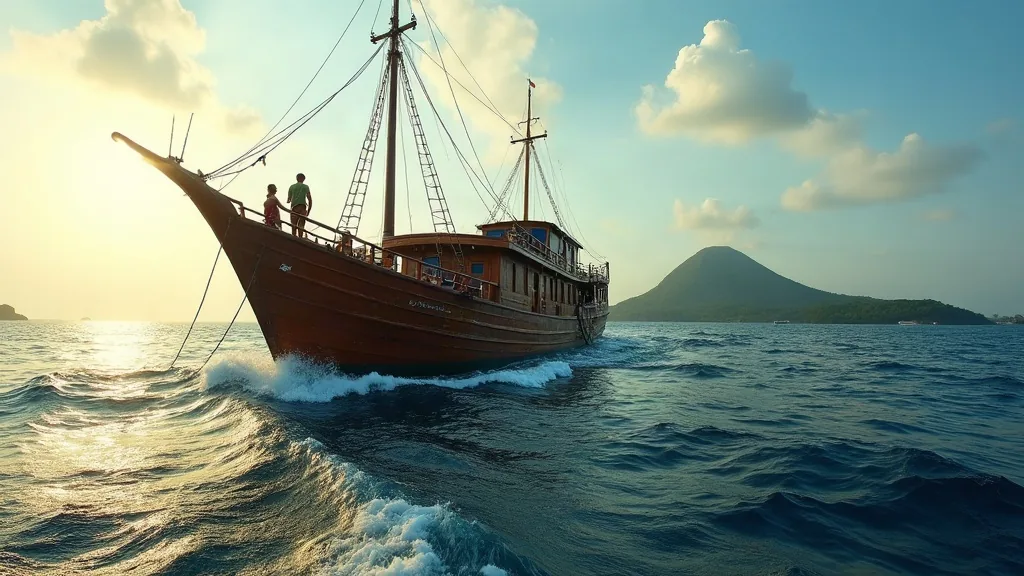
A hull launched at Tana Beru is not yet where it earns money. Between the yard and the Komodo or Flores cruising grounds lies a delivery passage through open water, and it is the leg owners most consistently leave out of the plan. It has its own crew requirements, its own weather window, its own paperwork and its own risk profile — on a vessel that has never been to sea.
Why the passage is its own project
Three things make a delivery voyage different from ordinary operation. The vessel is new and untested. It is frequently not yet in its final fit-out condition. And the people aboard are usually a delivery crew rather than the operating crew who will come to know the boat.
A new wooden hull is also still taking up. Planking swells and seams close over the first days afloat, and some weeping is expected — as noted in the launch. Departing on a long passage before that process has settled and been observed means going to sea without knowing which weeps were normal and which were not.
The route, in outline
From the south-eastern tip of South Sulawesi the passage runs generally south-east across open water toward the Flores region, then east along the northern Flores coast toward Labuan Bajo and the Komodo area. It is not a coastal hop. There are substantial open-water stretches, and the region’s currents — particularly through the straits — are strong and tidally driven.
Distances are modest by ocean standards and significant for a newly launched vessel making its first passage. The seamanship question is not whether the distance is achievable; it is what the vessel and crew do if something needs attention halfway across.
What has to be in place before departure
- Certification and registration appropriate to the passage. A vessel that is not yet registered is a vessel with a complicated problem if it is boarded, damaged, or needs to enter a port formally — see registration and classification.
- Insurance that actually covers a delivery voyage. Delivery is frequently excluded or separately underwritten. Confirm it in writing rather than assuming a policy extends to it.
- Sea trials before the passage, not as the passage. Machinery, steering, bilge pumping and electrical systems proven close to the yard, where a problem is an inconvenience rather than an emergency.
- A competent delivery crew with the relevant qualifications and local knowledge of the currents and the weather patterns.
- Bilge monitoring capability. On a newly launched wooden hull this is not optional — pumps proven, alarms working, and someone watching.
- A weather window chosen for the season, with a realistic hold plan if it closes.
- Safety equipment, communications and a passage plan appropriate to open water.
The scheduling trap
The launch date cannot be fixed in advance because it depends on the tide. The delivery voyage cannot be fixed in advance because it depends on the launch, on take-up, on sea trials and on weather. Yet owners routinely book the first charter, the delivery crew’s flights, and sometimes a photography shoot against a launch date that was always provisional.
Planning backwards from the revenue date and building genuine slack between each of these steps is the only structure that survives contact with reality. This is one of the reasons build time should be counted backwards from when the vessel must be earning rather than forwards from the keel.
Where the fit-out happens changes the passage
If machinery and interior are completed at or near the yard, the vessel that departs is close to finished and the passage is a delivery of a working boat. If the hull is delivered elsewhere for fit-out, the passage is made by an incomplete vessel — often with temporary systems, minimal accommodation and no interior. That is a legitimate and common approach, but it is a materially different voyage and should be planned as one.
Deciding this boundary is part of the contract scope discussion in commissioning a build, and it belongs in the specification rather than being settled by circumstance at launch.
What the passage tells you about the boat
There is a real benefit hiding in this leg. A delivery voyage is the most informative shakedown the vessel will ever get, and it happens while the builder is still reachable and while a retention is, if the contract was written properly, still held — see stage payments.
Things worth documenting during the passage: how the hull takes up and whether weeping reduces; how she behaves in a seaway; vibration and alignment under load; steering and handling; where water finds its way in on deck; and the temperature and behaviour of the machinery over sustained running. That record is the basis for the punch list, and it is far more useful than any inspection alongside.
Arriving
Once in the cruising grounds the vessel enters its operating life, which brings a different set of requirements: crew, maintenance planning, haul-out cycles, owner reporting and compliance. Technical and commercial vessel management is contracted separately with PT Komodo Vessel Management, and the haul-out cycle that will determine the hull’s working life is covered in hull life.
The delivery voyage is the seam between two projects — a build that is ending and an operation that is beginning. Owners who plan it as a leg of the build, with its own budget, crew and window, arrive with a vessel and a punch list. Owners who treat it as a transfer arrive with a surprise. And for a sense of what the vessel is arriving into, it is worth looking at the charter life a finished hull sails into at Komodo — the operating world most Tana Beru newbuilds are ultimately built for.
Frequently asked questions
Is the delivery voyage part of the build contract?
Usually not by default. It should be addressed explicitly in the contract scope, including who crews it, who insures it, and whether the vessel departs complete or in a partly fitted-out condition.
Why should a newly launched wooden hull not depart immediately?
Because the planking is still taking up. Seams close over the first days afloat and some weeping is expected. Departing before that has settled means going to sea without knowing which weeps were normal and which indicated a problem.
Does standard insurance cover a delivery voyage?
Frequently not. Delivery passages are often excluded or separately underwritten, so cover should be confirmed in writing rather than assumed to extend from a general policy.
What should be done before the passage?
Sea trials close to the yard proving machinery, steering, bilge pumping and electrical systems; registration and certification appropriate to the voyage; confirmed insurance; a competent delivery crew; working bilge monitoring; and a chosen weather window with a hold plan.
What is the benefit of the delivery voyage to an owner?
It is the most informative shakedown the vessel will ever get, and it happens while the builder is still reachable and a contract retention is still held. How the hull takes up, behaves in a seaway and where water enters on deck all form the punch list.