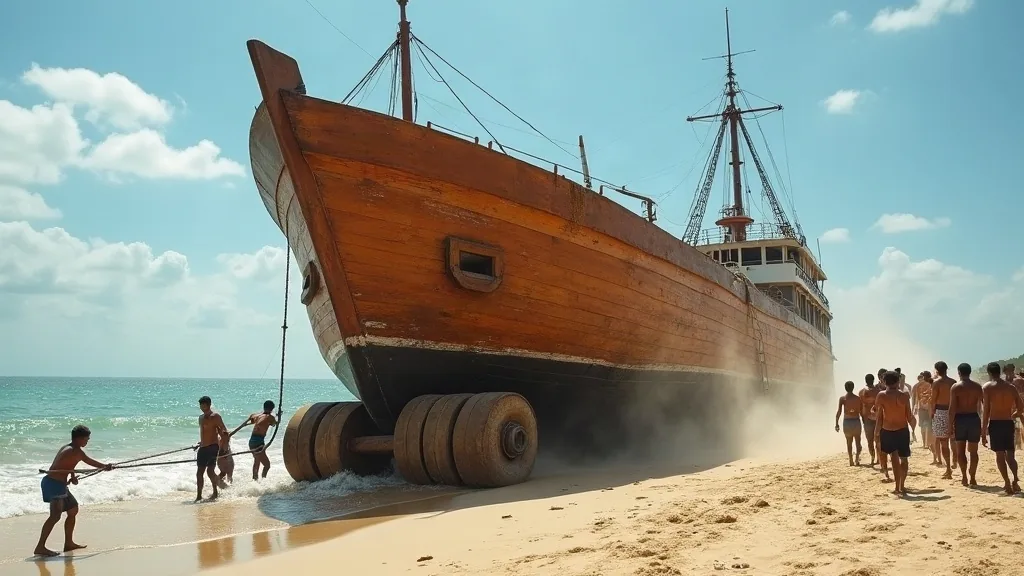
There is no crane, no travel lift and no launch ramp at Tana Beru. A finished hull weighing many tonnes is moved to the sea across sand, on greased timber ways and rollers, hauled by ropes and a large number of people working together on a rising tide. It is the most spectacular thing that happens at the yard and the most dangerous, and it is the reason no launch date can be promised in advance.
The physics of the problem
A large wooden hull sits above the tideline on timber blocks and shores, sometimes tens of metres from water deep enough to float it. It cannot be lifted — there is nothing to lift it with. It has to be slid, and sand does not slide.
The solution is old and effective: build a temporary road under the hull. Timber ways are laid along the intended path, heavily greased. Rollers go between the ways and the hull’s cradle. Then the load is broken free and moved incrementally, with the ways being taken up from behind and relaid ahead as the vessel advances. Friction is the enemy at the start and gravity is the ally at the end, because the beach slopes toward the water.
Tide governs everything
The hull only needs to travel far enough to float, so the higher the water, the shorter and safer the move. Launches are therefore timed to the highest tides available, which means the date is set by the moon rather than by a calendar. Spring tides around the new and full moon give the working window.
This is why a launch cannot be scheduled months ahead with confidence, and why owners should never book a delivery crew, a photographer or a delivery voyage against a fixed launch date. Build slack in. The delivery voyage is a real programme leg and it should start after the launch has happened, not on the day it was hoped for.
People, ropes and coordination
The hauling is done by people — often a substantial part of the village — pulling together on ropes and tackle, with levers and wedges working the hull off its blocks and keeping it tracking straight. Coordination is verbal and rhythmic: the load has to move as one pull, because a hull that starts and stops shears its rollers and digs in.
Mechanical assistance appears at some launches, but the fundamental method is collective human effort, which is why a launch is a village event rather than a contractor’s operation. It is also the clearest demonstration of something visitors often miss — that a vessel here is built by a community and not merely by a firm. The master shipwright directs it, and the blessing that precedes it is part of the operation rather than an addition to it, as covered on the ceremonies page.
Why it is the most hazardous moment at the yard
Everything that makes a launch impressive makes it dangerous. Enormous mass with real momentum. Ropes under load, which whip if they part. Timber shores being knocked out deliberately. Rollers that can shoot out sideways. A hull that can slew if one side moves faster than the other. And a crowd, including children, standing where the view is best rather than where it is safe.
For a visitor the rules are simple and non-negotiable: stay well back and to the side, never stand behind or inside a rope run, never stand downhill of the hull, and never get between the vessel and the water. If you are photographing, use a long lens from a distance — the photography guide covers the framing without the proximity.
What happens once it floats
Floating is not finishing. A newly launched wooden hull takes up — the planking swells as it absorbs water and the seams close. Some weeping in the first days is expected and is not automatically a defect; what matters is whether it reduces as the timber takes up, and whether the caulking was properly done in the first place.
The vessel is then usually moved to a mooring for the next phase: machinery, systems, interior. That work is frequently done elsewhere entirely, and the boundary between hull scope and fit-out scope is one of the most important lines in a build contract — see commissioning a build and what drives build time.
Can visitors watch a launch?
Sometimes, but there is no published schedule because there is no operator publishing one — the same structural fact that explains the absence of a ticket booth. Launches happen when a hull is ready and the tide is right, and word travels locally rather than through any listing.
If seeing one matters to you, the only reliable approach is to be in the area around the spring tides, ask at the yard when you visit, and be prepared for it not to happen. Visitors who plan an entire trip around witnessing a launch are usually disappointed; those who spend a few mornings at the yard and get lucky are not. The visiting guide covers asking locally.
Why it still matters
The launch is where the abstraction collapses. Everything else at Tana Beru can be read as craft or heritage or process. The launch is a large object, built by hand without drawings by people who live within sight of it, being moved into the sea by everyone available. It is a working operation that happens to also be one of the most striking things you can see on this coast — and it ends a programme that began with a keel blessing many months earlier, as set out in the build timeline.
Frequently asked questions
How is a wooden hull launched at Tana Beru?
On greased timber ways and rollers, hauled across the sand by ropes and collective human effort on a rising tide. There is no crane, travel lift or launch ramp — the hull slides down the beach on a temporary timber road laid and relaid ahead of it.
Why can a launch date not be fixed in advance?
Because it depends on tide. The hull only needs to travel far enough to float, so launches are timed to the highest tides around the new and full moon. The date is set by the moon, not by a calendar.
Is it safe to watch a launch?
Only from well back and to the side. There is enormous mass with momentum, ropes under load that can whip if they part, shores being knocked out and rollers that can shoot sideways. Never stand behind a rope run, downhill of the hull, or between the vessel and the water.
Does a newly launched hull leak?
Some weeping is normal in the first days while the planking takes up water and the seams close. What matters is whether it reduces as the timber swells, which depends on whether the caulking was properly done.
Can I plan a trip around seeing a launch?
Not reliably. There is no published schedule because there is no operator running the site. Being in the area around spring tides and asking locally gives you a chance, but it should not be the sole purpose of a trip.