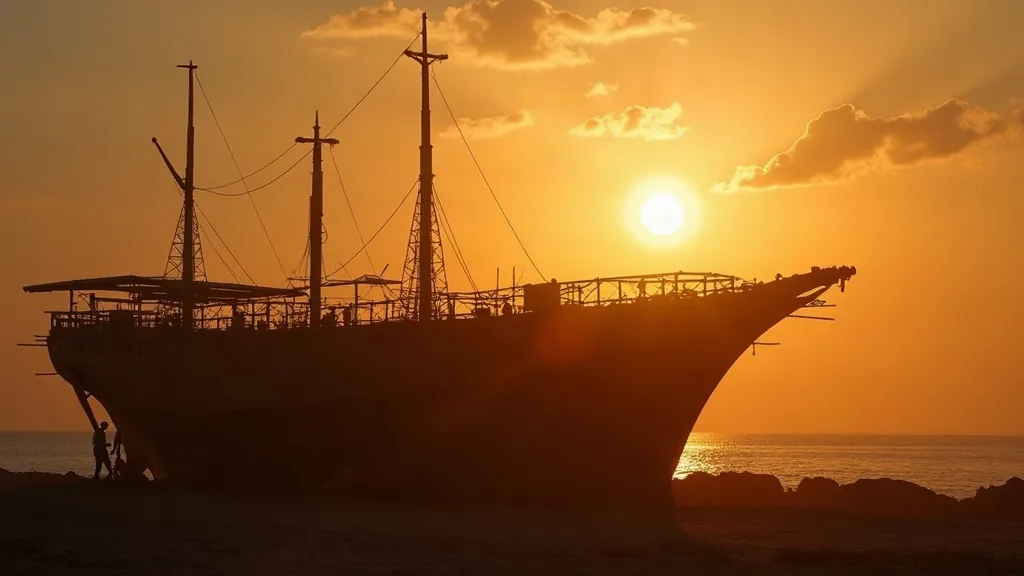
Two windows work at Tana Beru: the first two hours after sunrise, and the last hour before sunset. Morning gives you texture and activity; evening gives you shape and silhouette. A wide and a short telephoto cover almost everything. And the single most important piece of equipment is a greeting, because access here depends on courtesy rather than on a permit.
The two windows, and what each gives you
Morning: 06:30–09:00
This is the working window and the detail window. The sun is low and comes along the shoreline rather than down onto it, which means light rakes across the planking. Adze marks, dowel ends, the fairness of a strake, the grain of freshly worked timber — none of it exists in midday light and all of it appears at 07:00. Crews are also active, so you get hands, tools and movement rather than static timber.
Evening: the hour before sunset
This is the shape window. The hulls become dark masses against a bright sea, scaffolding turns to line-work, and dust and haze in the air catch the low sun. Work has largely stopped, so this is not the window for process photography — it is the window for the single strong image of a hull silhouetted against water.
Between roughly 10:30 and 16:00 the light is overhead and hard, the sand blows out, and the hulls lose all their surface detail. It is not that you cannot photograph then; it is that you will be fighting the conditions for a result the morning would hand you.
Lenses
| Lens | What it is for |
|---|---|
| 24–35mm equivalent | The hull in its setting: vessel, scaffolding, beach, village behind. The establishing frame |
| 50mm equivalent | Working detail without crowding anyone — tools, hands, plank joints at a respectful distance |
| 85–135mm equivalent | Compression along the shoreline, stacking the row of hulls into one frame. The most underused focal length here |
| Very wide (under 20mm) | Interiors of half-planked hulls, looking up through the shell. Dramatic, and genuinely hard to get any other way |
If you bring one lens, make it a 24–70 equivalent. If you bring two, add the short telephoto rather than anything wider — the compressed shoreline shot is the one most visitors come home without.
The frames worth working for
- Inside a half-planked hull, looking up. The shell curving overhead with daylight between the strakes, and no frames yet in place. It is the picture that explains the shell-first method without a caption.
- Along the keel from the stem. Low, tight to the ground, sighting down the backbone. Shows scale and shows fairness.
- The turn of the bilge in raking light. The hardest curve in the vessel, and the one that shows the crew’s skill.
- Dowel ends and seam. Macro-adjacent detail of the joinery described on the method page.
- The compressed row. Long lens from one end of the shoreline, hulls stacking into each other.
- Timber stacks under palm shelter. End grain, sawdust, dappled light. Quiet, and it carries the material story.
Manners, which are the actual access control
There is no permit for personal photography at Tana Beru and no one to ask for one. What governs access is whether crews remain comfortable with people walking through their workplace with cameras. That is a renewable resource and photographers are the group most likely to spend it.
- Greet first. A word, a nod, a gesture at the camera. It takes three seconds and it changes the entire tenor of the encounter.
- Faces need consent; vessels do not. Wide scenes with people working at a distance are normally fine. A close portrait is a different act and should be treated as one.
- Do not direct. Asking someone to swing an adze again for the shot turns a workplace into a set. If you need directed work, that is a commercial shoot and should be arranged and compensated.
- Do not climb. Scaffolding is built for the crew’s weight and habits.
- Drones: tell people. Regulatory compliance is your responsibility, and social compliance is separate from it. Never hover over people or over a hull being moved. Detail is on the photography and filming page.
- Send pictures back. If you promise a photograph, actually send it. The number of photographers who have promised and not delivered is the reason some crews now decline.
Practical kit notes
Sawdust and fine sand are constant, so change lenses as little as possible and consider a two-body approach if you have it. There is almost no shade once you leave the workshop shelters, which affects you before it affects the camera. Closed shoes, as everywhere in the yard. A polariser is useful for the sea, less so for the timber. Bring more water than you think.
Where to be, and when
Arrive by 06:45 at the western end and work east with the sun behind you; the morning walking route follows exactly that line. Come back for the last hour of light if you are staying nearby — the run from Bira is only twenty minutes, which makes a two-window day entirely practical.
A note on this site’s own imagery: illustrative images here are AI-generated and are not documentary photographs of specific vessels, crews or events at Tana Beru.
Frequently asked questions
When is the light best for photographing Tana Beru?
Two windows. The first two hours after sunrise give raking light along the planking plus active crews, and the last hour before sunset gives silhouettes of the hulls against the sea. Between roughly 10:30 and 16:00 the overhead light flattens everything.
What lenses should I bring?
A 24–70mm equivalent covers most of it. If you add a second lens, make it a short telephoto around 85–135mm for compressing the row of hulls along the shoreline, which is the shot most visitors come home without.
Do I need permission to photograph people at the yard?
For close portraits and recognisable faces, yes — greet the person and gesture at the camera first. Wide scenes with people working at a distance are normally fine, and vessels themselves need no permission for personal photography.
Can I fly a drone for photographs?
Only after confirming Indonesian civil aviation requirements for your aircraft and flight, and after telling the crews working below. Never hover over people or over a hull being moved.
What is the single best frame at Tana Beru?
Standing inside a half-planked hull looking up through the shell, with daylight between the strakes and no internal frames yet fitted. It demonstrates the shell-first construction method in a single image.