At Tana Beru the hull is built shell-first and without drawings. Planks are shaped and joined edge to edge with wooden dowels until they form a self-supporting shell, and only then are the internal frames fitted inside the shape that already exists. The form is held in the judgement of the panrita lopi, the master shipwright, and checked by eye, batten and hand rather than by a lines plan.
Shell-first, frames after
This is the technical heart of the method and the thing that most surprises anyone trained in conventional boatbuilding. The ordinary Western sequence erects a skeleton of frames and bends planking onto it, so the frames define the shape. Here the sequence runs the other way. The keel, stem and sternpost are laid, the garboard strake is fitted against the keel, and then strake after strake is added, each edge-fastened to the one below with hardwood dowels driven into drilled holes. The shell rises on its own and holds its own curve. Frames go in afterwards, fitted to a hull that has already decided what it is.
The implication is that the shape is committed early, incrementally, and irreversibly by hand. There is no drawing to correct against and no mould to check. Each plank’s bevel and twist is cut to fit the one before it. Get one wrong and the error travels the length of the hull. The consequences of that inverted logic deserve their own reading.
Dowels, not nails
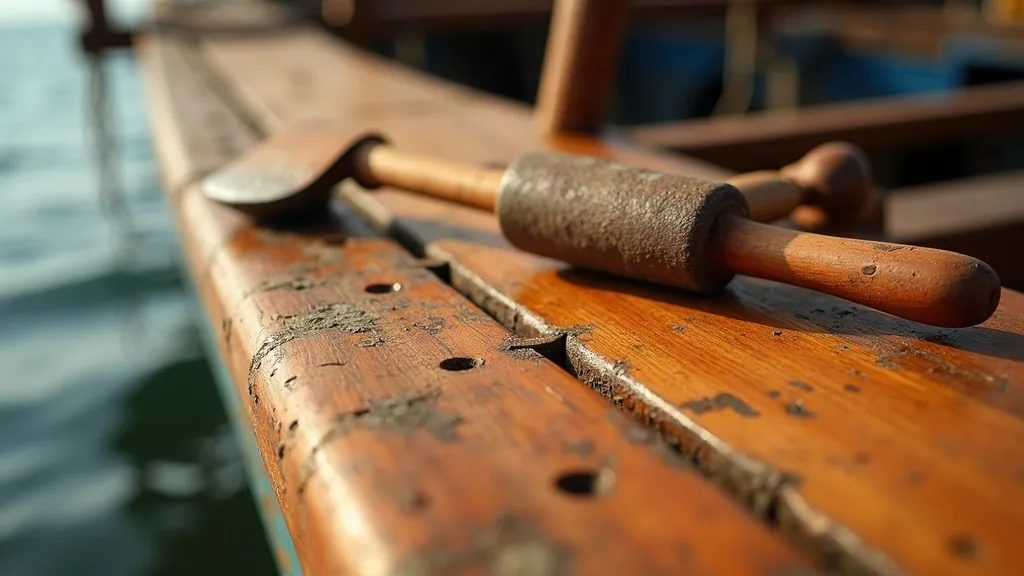
The edge-to-edge fastening is done with wooden dowels — pasak — driven into holes bored through the edge of one plank and into the edge of its neighbour. Wood against wood swells with the same moisture and moves with the same seasons, which is why the joint stays tight where an iron fastening would corrode, weep and split the timber around it. Metal fastenings do appear in modern hulls, particularly at high-load points and for machinery foundations, but the shell itself is a wooden structure held by wooden pins.
Seams between strakes are then caulked and payed, and the whole hull faired before coatings. The quality of that caulking is one of the strongest predictors of how the hull will behave in its first year afloat.
Measured by eye, not by plan
There is no lines plan, no table of offsets and no CAD model behind a traditional hull here. What exists instead is a set of proportional rules held by the master shipwright — relationships between length, beam, depth and the rise of the sheer — plus a practised eye. Battens are sprung along the hull to test fairness; a hand run along a plank finds a flat spot faster than an instrument would. Where a modern yard checks against a drawing, this yard checks against a judgement that has been trained over decades.
That judgement is a person, not a document, and it is the constraint that everything else runs into. Who those people are, and how the knowledge is transmitted, is covered in the page on the panrita lopi and — less comfortably — in the apprenticeship gap.
Ritual as part of the process
The master shipwright’s authority is technical and ceremonial at once. The keel laying is marked with a blessing, and the launch with a ceremony; both are part of the build rather than decoration attached to it. Treating them as optional causes friction, and they occupy real days in the programme. The ceremonies page sets out what happens and when.
What this means for a modern owner
Three practical consequences follow from a shell-first, drawing-free method:
- Specification has to be written in words and numbers, not drawings. Principal dimensions, timber species and scantlings, fastening type, deck layout and equipment schedule all belong in the contract text because there is no plan set to point at.
- Verification has to be physical. You cannot check a hull against a drawing that does not exist, so inspection is done at physical milestones — see the build timeline.
- Classification requires translation. If the vessel is to be classed or registered, the as-built hull has to be documented and assessed after the fact rather than approved in advance. Registration and classification covers that route.
None of this makes the method unsuitable for a commercial vessel — a very large share of Indonesia’s liveaboard fleet came off these beaches. It makes the method different, and the difference has to be managed deliberately. Independent verification at each milestone is what turns craft judgement into something an owner can rely on, which is the subject of newbuild supervision.
Frequently asked questions
Are wooden vessels at Tana Beru really built without plans?
Yes, in the traditional method. There is no lines plan or table of offsets. The hull’s shape comes from proportional rules and the trained judgement of the master shipwright, tested with battens and by hand as the planking rises.
What is shell-first construction?
Planks are shaped and fastened edge to edge with wooden dowels until they form a self-supporting shell, and the internal frames are fitted afterwards inside that finished shape. It is the reverse of the frame-first sequence used in most Western wooden boatbuilding.
Why are wooden dowels used instead of nails?
Wood moves with moisture at the same rate as the planks it joins, so the joint stays tight. Iron fastenings corrode in a wet hull, weep rust into the timber and split the wood around them.
Who is the panrita lopi?
The master shipwright who holds authority over a build. The role is technical and ceremonial at once — responsible for the hull’s form and for the blessings at keel laying and launch.
Can a hull built this way be classified or registered?
Yes, but the route is different. Because there is no approved plan set in advance, the as-built vessel is documented and assessed after construction rather than approved before it.