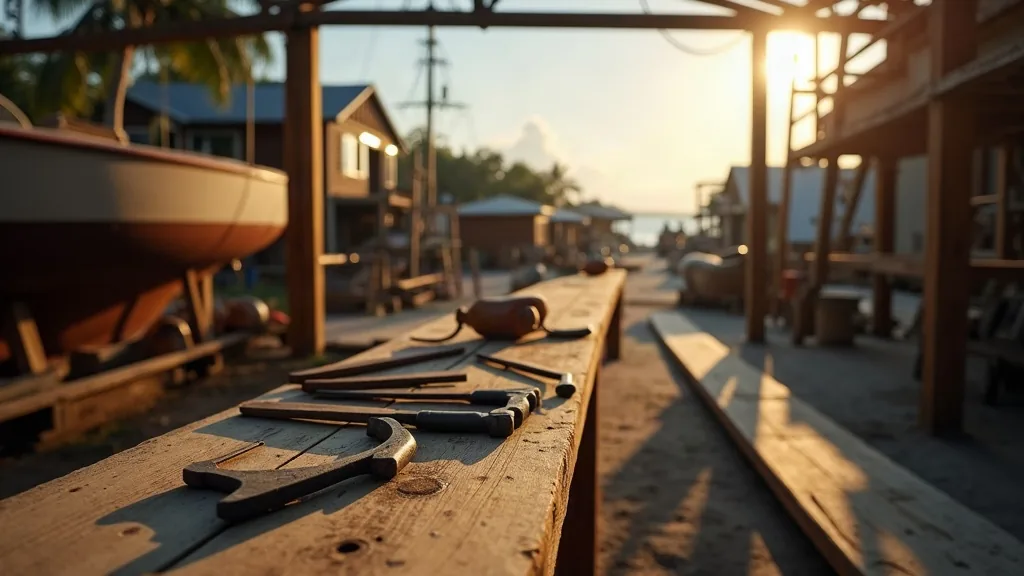
Walk the shoreline at Tana Beru and count ages. That single observation tells you more about the future of this craft than any amount of heritage writing. The knowledge that shapes a hull without drawings lives in people and transmits by apprenticeship over decades — which means it can be lost in a single generation that chooses differently, and no listing, documentary or museum can restore it.
Why this is a structural risk, not a sentimental one
In a frame-first tradition with drawings, a plan set outlives the builder. A competent crew with the lines can reproduce the hull. The knowledge is at least partly external, stored in documents.
At Tana Beru the shape is carried by the panrita lopi — proportional relationships, judgement of fairness, the continuous decisions that a shell-first build demands plank by plank. There is no drawing to hand on, as the inverted build logic explains. What gets handed on is a person’s trained perception, and the only known transfer mechanism is years of working alongside someone who has it.
That makes succession the single point of failure. Timber shortages are severe but tractable — species can be substituted, hulls can be maintained longer, supply chains can be formalised. A break in transmission is not tractable. You cannot reconstruct embodied judgement from photographs of finished boats.
Why fewer young people take the path
The reasons are ordinary and largely economic, which is why they are difficult to argue with.
- The apprenticeship is long. Decades to full competence, in a labour market where other work pays sooner.
- The work is hard and physical, outdoors, in heat, with real injury risk and no formal safety regime.
- Income is irregular. Crews work order to order, and orders depend on timber availability and on payment rhythm — see what drives build time.
- There is no certificate at the end. The credential is reputation within a community, which does not transfer to another industry or another island.
- Alternatives are visible. Tourism, transport, construction, work abroad — all pay sooner, and all are now within sight of a young person in Bonto Bahari.
None of this reflects a loss of interest in heritage. It reflects a rational assessment by people with families and options.
What the gap looks like on the beach
You can read it directly if you know what to look for. Are older and younger people working the same hull, or are the crews uniformly middle-aged and older? Is anyone doing the apprentice work — fetching, holding, cleaning up, watching — as a route into the trade rather than as casual labour? Is anyone being taught, as distinct from being employed?
Visitors on the morning walking route usually photograph the hulls. The more informative observation costs nothing and takes five minutes.
What does not fix it
Recognition alone. The 2017 UNESCO inscription raised visibility substantially and created no income for any crew. Visibility is not the constraint — see what the inscription changed.
Documentation projects. Recording the craft on film and in writing is worth doing, and it preserves a record rather than a capability. A hull cannot be built from an archive.
Tourism. Visitors bring some income to the wider village economy and none to the crews building hulls, since there is no ticket and no organised visiting — as covered here. Tourism can even harm transmission by making other livelihoods more attractive.
Museum vessels. A boat built for display teaches the crew that builds it and then stops. Demonstration is not practice.
What actually helps
One thing dominates: continuous work at decent value.
A crew with a steady order book can afford to carry apprentices, because there is enough work to absorb someone who is slow while learning. A crew working sporadically cannot — every pair of hands must be productive immediately. Order flow is therefore the transmission mechanism, indirectly but decisively.
Several things follow for anyone in a position to place work here:
- Pay properly and on time. Late payment fragments a crew’s work, as stage payments explains, and fragmented work is where apprentices are the first to be dropped.
- Commission refits, not only new builds. Refit work is more regular, less dependent on scarce large-dimension timber, and uses the same skills.
- Maintain vessels here rather than elsewhere where practical, which keeps a steady baseline of work between build orders.
- Specify documented timber and accept the wait. A legitimate supply chain is a more durable one, which supports continuity of work — see the wood question.
- Do not squeeze on price to the point where a crew cannot carry anyone learning. The saving is real and short; the cost is borne by the craft.
The honest assessment
Hulls are still being built at Tana Beru, and skilled shipwrights are still working. The craft is not gone and this is not an obituary. But the transmission mechanism is under measurable strain, and it operates on a timescale — decades to competence — that leaves very little room to react late. A tradition that stops transmitting continues to look healthy for many years, because the existing masters keep working. The gap only becomes visible when they stop, and by then it is not recoverable.
The practical conclusion is unglamorous and it is the same one that runs through the UNESCO piece: what safeguards this craft is orders, paid properly, over a long period. Everything else is commentary — including this article. Contracts in this service class are issued by PT Komodo Galangan Nusantara, with values stated in USD; see commissioning a build.
Frequently asked questions
Why is succession the main risk to wooden shipbuilding at Tana Beru?
Because the knowledge is embodied rather than documented. There is no plan set to hand on — the hull’s shape lives in the master shipwright’s trained judgement, and the only known way to transfer it is years of working alongside someone who has it.
Why do fewer young people enter the trade?
Largely economic reasons. The apprenticeship takes decades, the work is hard and physical with real injury risk, income is irregular because crews work order to order, there is no transferable certificate at the end, and alternatives pay sooner.
Did the UNESCO inscription help with this?
It raised visibility substantially and created no income for any crew. Visibility was never the constraint, so recognition alone does not address transmission.
Can the craft be preserved through documentation and museums?
Documentation preserves a record rather than a capability, and a vessel built for display teaches the crew that builds it and then stops. A hull cannot be built from an archive.
What actually helps?
Continuous work at decent value. A crew with a steady order book can afford to carry apprentices who are slow while learning; a crew working sporadically needs every pair of hands productive immediately. Regular refit work helps as much as new builds.