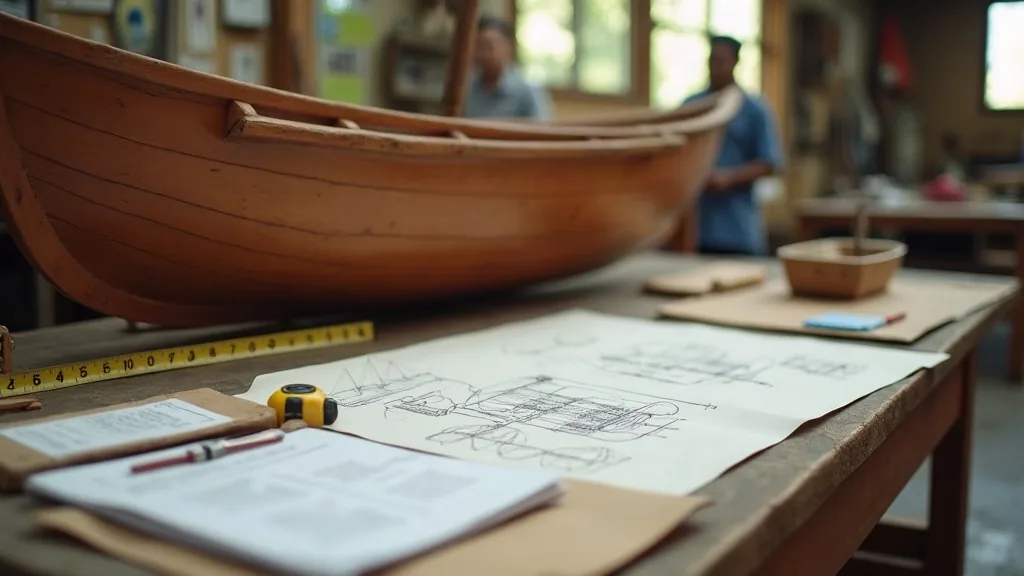
Commissioning at Tana Beru works through a written specification and a milestone-linked payment schedule, not a drawing set and a deposit. Because the hull is built shell-first without plans, the contract has to carry in words what a plan set would otherwise carry: principal dimensions, timber species by member, scantlings, fastening type, equipment schedule, and the physical milestones at which money changes hands.
The sequence, start to handover
| Step | What happens | What you leave with |
|---|---|---|
| 1. Brief | Intended use, guest or cargo capacity, cruising area, target season | Written statement of purpose |
| 2. Concept and dimensions | Principal dimensions and general arrangement agreed with the master shipwright | Dimensions, layout, capacity |
| 3. Specification | Timber by member, scantlings, fastenings, machinery, systems, equipment | Written specification schedule |
| 4. Timber precondition | Species, quantity and seasoning state confirmed and documented | Timber availability statement |
| 5. Contract | Milestones, stage payments, supervision rights, rejection rights, handover test | Signed build contract in USD |
| 6. Build | Keel to launch, inspected at each physical milestone | Milestone sign-offs and photographic record |
| 7. Launch and fit-out | Hull to water; machinery and interior, often at another location | Completed vessel |
| 8. Survey, registration, handover | Independent survey, documentation, acceptance | Vessel and its papers |
Write the specification in words, because there is no plan
This is the single adjustment that most owners arriving from a European or Australian yard have to make. There is no lines plan to approve, no CAD model to sign off and no mould to inspect. The hull’s shape lives in the master shipwright’s judgement — as described in the Konjo method — so anything you care about has to be written down explicitly:
- Length overall, beam, depth, draught, and displacement intent
- Timber species for keel, stem, frames, planking, decking and joinery — see the timber page
- Plank thickness, frame siding and moulding, frame spacing
- Fastening type and dowel material
- Deck layout, cabin count and arrangement, tankage
- Main engine, auxiliary, steering, electrical, plumbing and safety equipment
- Which scope is at Tana Beru and which scope is elsewhere
That last line prevents the most expensive misunderstanding in the process. A hull contract and a complete-vessel contract are very different commitments, and the commonly quoted build times in the timeline refer to the hull.
Owners who want drawings, naval-architecture input and a managed design-and-build programme rather than a village-contract build can route the same commission through full phinisi construction programmes coordinated from Labuan Bajo, which wrap the Tana Beru build methods described here in formal project management.
Stage payments against physical milestones
Work here is funded as it proceeds; material purchase follows payment. The correct structure ties each payment to a milestone that a person standing on the beach can verify as done or not done — keel and stem erected, garboard fitted, turn of the bilge planked, sheer strake closed, framing complete, decking laid, caulking and primer complete, launch. Percentage-complete milestones are unverifiable and should not appear.
Two protections are worth insisting on. First, payment released on inspection rather than on invoice date. Second, a retention held until after handover, so that defects found at survey have a remedy. How wooden vessel contracts are structured covers the mechanism in detail, including why a late payment costs more time than the length of the delay.
Who can commission, and under what structure
Foreign owners do commission vessels here. The questions that actually need answering early are ownership structure, the flag the vessel will fly, and what the vessel will be permitted to do commercially in Indonesian waters — because those answers change the specification, not just the paperwork. A vessel intended to carry paying guests under Indonesian flag has requirements that a private yacht does not. The honest answer on foreign commissioning sets out the considerations, and registration, flag and classification covers the documentation route.
Supervision is not optional
A build without independent inspection is a build you find out about at the end. Because there is no drawing to check against, verification has to be physical and it has to happen while each stage is still open — a frame you cannot see once the sole is laid is a frame you have accepted. Independent owner’s representation at each milestone is described in newbuild supervision, which is a separate scope from construction and is priced separately.
What a quotation depends on
There is no meaningful price per metre for a vessel of this kind. The figure moves with hull dimensions and displacement, timber species and seasoning state at signature, the extent of fit-out included, machinery and systems specification, classification and registration requirements, and delivery scope. A quotation is issued against a written specification, and it is stated in USD. The full breakdown of what moves the number — length, timber, fit-out, certification — is on the phinisi cost guide.
Before you ask for a number, it is worth being clear about what the hull is for. The three common business cases behind a commission — liveaboard, charter and working cargo — produce genuinely different vessels from the same starting point, and are compared in three business cases for one hull.
Contracting entity
Construction, repair, refit and vessel-sale contracts in this service class are issued by PT Komodo Galangan Nusantara. Boat-management contracts are issued by PT Komodo Vessel Management, and brokerage, central agency and charter marketing by PT Komodo Bahari Nusantara. Separate contracts, separate fees, separate ledgers. To open a specification discussion, see the contact page.
Frequently asked questions
How do I commission a wooden vessel at Tana Beru?
Through a written specification and a milestone-linked contract rather than a plan set and a deposit. You agree purpose and dimensions, write the specification in words, confirm timber availability, then sign a contract that ties stage payments to physical, verifiable milestones.
Why does the contract need so much written detail?
Because the hull is built shell-first without drawings. There is no lines plan to approve or check against, so anything the owner cares about — species, scantlings, fastenings, layout, equipment — has to be stated explicitly in the contract text.
What does a build cost?
There is no meaningful price per metre. Quotations are issued against a written specification and depend on dimensions, timber species and seasoning state, extent of fit-out, machinery and systems, classification requirements and delivery scope. Values are stated in USD.
Does the build price include the interior and machinery?
Not automatically. Hull-to-launch and complete-vessel are different scopes, and the commonly quoted build durations refer to the hull. The contract must state which scope is at Tana Beru and which is elsewhere.
Who issues the contract?
Construction, repair, refit and vessel-sale contracts in this service class are issued by PT Komodo Galangan Nusantara. Management and brokerage sit with separate entities under separate contracts.
Discuss this with the Tana Beru Shipyard Build Desk
WhatsApp +6281139414563 · bd@juaraholding.com
Contracts in this service class are issued by PT Komodo Galangan Nusantara. Quotations in USD.