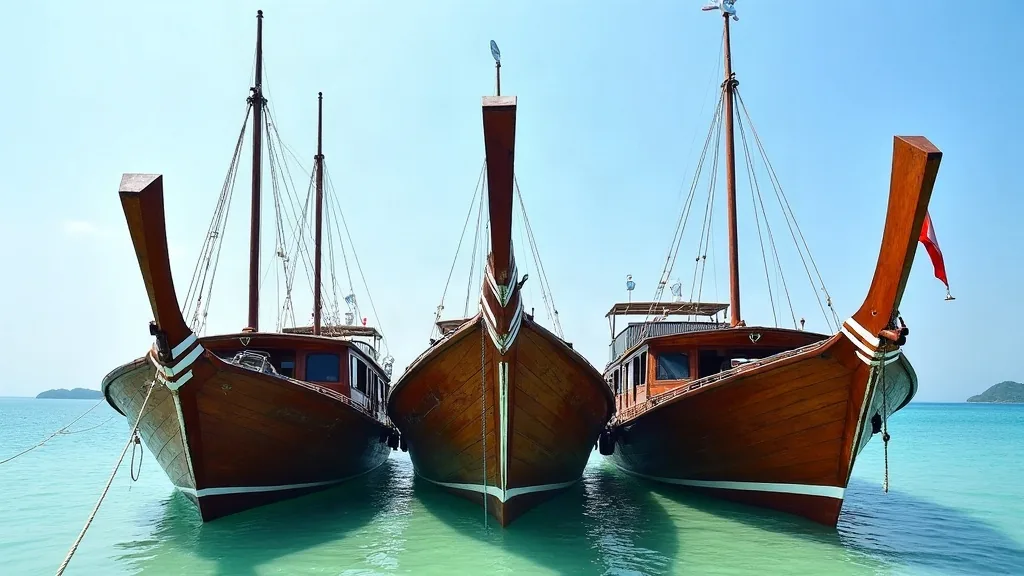
A hull commissioned at Tana Beru can become a diving liveaboard, a private charter yacht or a working cargo vessel. They start from the same construction method and the same crews, and they diverge almost immediately — in layout, tankage, certification, crew accommodation and cost. The decision is not a marketing choice made later. It is a construction decision that has to be made before the keel is laid.
Where the three diverge
| Diving liveaboard | Private charter yacht | Working cargo | |
|---|---|---|---|
| Guests | Higher numbers, shared cabins acceptable | Fewer guests, larger cabins, higher finish | None |
| Deck priority | Dive platform, tank storage, compressor space | Sun deck, lounging, tender handling | Hold access, hatches, deck cargo space |
| Tankage | High fresh water, long-range fuel | High fresh water, moderate range | Fuel focused, minimal fresh water |
| Interior standard | Functional, durable, high turnover | High specification joinery and systems | Minimal |
| Crew accommodation | Substantial — dive guides, cooks, deck crew | Substantial and separated from guests | Small |
| Certification burden | High — passenger carriage | High — passenger carriage | Different regime, cargo focused |
| Build cost | High | Highest | Lowest |
The diving liveaboard
This is the business model that built the modern Indonesian phinisi fleet, and much of it came off these beaches. The vessel is a platform for getting a group of divers to remote water and keeping them fed, dry and supplied with air for a week or more at a time.
The construction consequences are specific: a working dive deck and platform, secure tank storage, compressor space with ventilation, substantial fresh water tankage and range, and enough cabins to make the economics work. Guest expectations are functional rather than luxurious, but durability matters more than in almost any other model — a liveaboard turns over guests weekly and the interior takes a beating.
Revenue is per berth and depends on utilisation across a season. That makes cabin count a direct revenue variable, and cabin count is a hull dimension decision, not a decorating decision.
The private charter yacht
Fewer guests, larger cabins, higher finish, a different guest profile and a much higher build cost. The hull may be similar; the vessel is not. Interior joinery, systems, air conditioning, tender arrangements, crew separation and finish standards all move up, and the fit-out becomes a much larger share of the total programme.
This is the model where the twenty-to-twenty-four-month figure typically applies, and where the split between hull scope at Tana Beru and fit-out scope elsewhere most often makes sense — the yard’s timber competence is exceptional; a high-specification interior may be better executed by specialists elsewhere.
Revenue is per charter at a much higher day rate with lower utilisation. The economics are more sensitive to marketing, positioning and the quality of the operating crew than to cabin count.
The working cargo vessel
The oldest use, and still real. Wooden vessels carry goods between Indonesian islands, and the vessel built for that job is a different animal: hold volume prioritised, minimal accommodation, robust deck arrangements, simple systems and the lowest build cost of the three.
It is worth including here for two reasons. First, because it is the trade the type came from, and understanding it explains a great deal about why the hull form is what it is. Second, because owners occasionally discover that their romantic idea of a charter vessel is really a cargo vessel with cabins added — which produces a boat that does neither job well.
Why the decision cannot wait
In a shell-first build the hull’s dimensions commit early: once the keel is down and the garboard is on, length, beam and depth are effectively fixed, as explained in why the hull comes first. Cabin count, tankage volume, hold arrangement, machinery space and bulkhead positions all follow from those dimensions.
Certification compounds it. A vessel intended to carry paying guests faces requirements — safety equipment, stability documentation, escape routes, crew accommodation — with physical consequences committed during construction, not after. Retrofitting them is expensive and sometimes impossible; see registration and classification and the honest answer on foreign commissioning.
Questions to answer before writing the specification
- Who is the guest, and how many at a time?
- How many nights per trip, and how many trips per season?
- What is the cruising area, and what range and tankage does it demand?
- Under what flag and what certification will the vessel operate?
- What crew is required, and where do they sleep?
- What is the target day or berth rate, and what utilisation is realistic?
- Who operates it — you, or a management company?
- What is the intended holding period and exit?
Those answers become the specification. Without them, the specification becomes a set of assumptions that nobody wrote down, which in a build with no drawings is the same as having no specification at all — see commissioning a build.
The operating reality that follows
All three models share one thing: the hull is a wooden structure whose working life is decided by the maintenance cycle, not by the build. A liveaboard running hard for a season and skipping a haul-out is on a faster path to major plank replacement than any specification decision can offset. Hull life sets out why, and technical and commercial vessel management — crew, maintenance planning and owner reporting — is contracted separately with PT Komodo Vessel Management.
Construction contracts in this service class are issued by PT Komodo Galangan Nusantara, with values stated in USD. To discuss which model fits your intentions, see the contact page.
Frequently asked questions
Can one hull design serve as a liveaboard, a charter yacht or a cargo vessel?
Not well. They share a construction method and often a similar hull form, but they diverge immediately in layout, tankage, cabin count, crew accommodation, certification and finish. A vessel built to do all three tends to do none of them well.
When does the business model have to be decided?
Before the keel is laid. In a shell-first build the hull dimensions commit early, and cabin count, tankage, bulkhead positions and machinery space all follow from those dimensions.
Which model has the highest build cost?
The private charter yacht, because interior joinery, systems, air conditioning, tender arrangements and finish standards raise the fit-out substantially. Working cargo vessels have the lowest build cost of the three.
Where does the fit-out usually happen?
For a diving liveaboard, often at or near the yard. For a high-specification charter yacht, the hull is frequently built at Tana Beru and the interior completed by specialists elsewhere, which also changes the delivery voyage.
Does the business model affect certification?
Substantially. Carrying paying guests brings requirements for safety equipment, stability documentation, escape routes and crew accommodation that have physical consequences committed during construction and are expensive or impossible to retrofit.