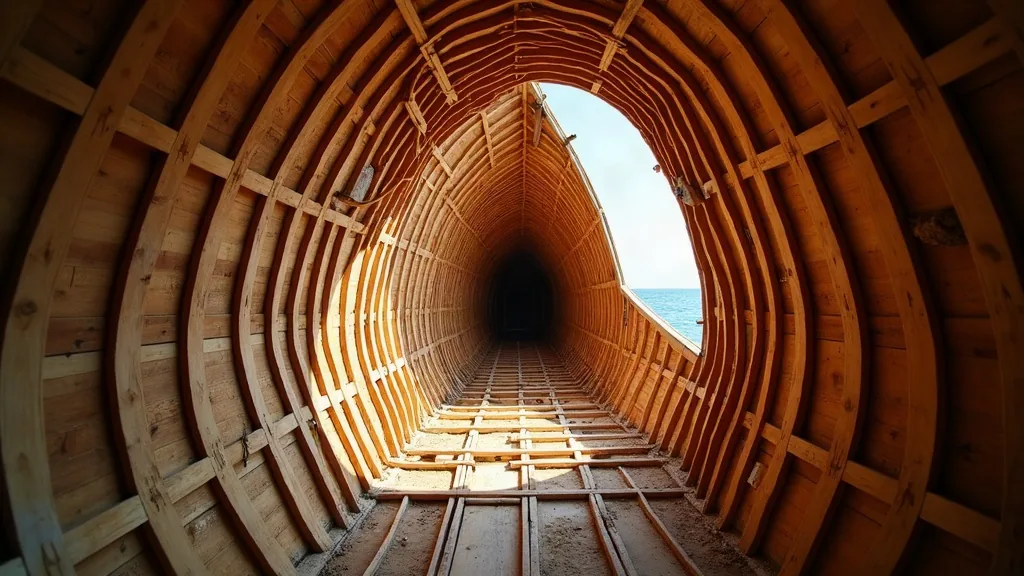
In a Konjo build the planks come first. Strakes are shaped and dowelled edge to edge until the shell stands on its own, and the internal frames are fitted afterwards, inside a hull that already has its shape. To anyone trained on frame-first construction this looks backwards. It is not — it is a different and internally consistent way of arriving at a fair hull, and it has consequences that reach all the way into a build contract.
Two ways to arrive at a hull
Frame-first is the familiar sequence: erect a skeleton of frames from a lines plan, then bend planking around it. The frames define the shape, the drawing defines the frames, and the planking follows what it is given. Correction happens on paper, before any timber is cut.
Shell-first inverts that. Keel, stem and sternpost go down. The garboard — the first strake against the keel — is fitted. Then each successive plank is shaped to land against the edge of the one below it and fastened to it with wooden dowels. The hull grows outward and upward as a self-supporting shell. Only when the shell is closed do the frames go in, cut and fitted to a curve that already exists.
Both produce a fair hull. They locate the intelligence in completely different places.
Where the shape actually lives
In frame-first, the shape lives in the drawing. Anyone with the drawing can produce the hull, and the drawing outlives the builder.
In shell-first at Tana Beru, the shape lives in a person. The panrita lopi holds a set of proportional relationships — length to beam, beam to depth, the run of the sheer — and applies them with a trained eye, tested by springing a batten along the hull and by running a hand over a plank to find a flat spot faster than an instrument would. There is no drawing to check against because there is no drawing. The method page sets out the technique; the point here is what the method implies.
It implies that the knowledge is embodied and transmitted person to person, over years. That is why the succession question in the apprenticeship gap is not sentimental — it is structural. Lose the people and you lose the drawings, because the people were the drawings.
Why edge-fastening makes it work
A shell cannot stand on its own unless the planks are genuinely joined to each other rather than merely resting side by side. That is what the dowels do. Holes are bored through the edge of one plank into the edge of its neighbour, and hardwood pins are driven in. Plank to plank, strake by strake, the shell becomes a single stressed skin.
Wood against wood is the right choice here and not a compromise. The dowel takes up moisture at the same rate as the planks around it, so the joint swells and shrinks as one piece of material. An iron fastening in a permanently wet hardwood hull corrodes, weeps rust into the surrounding timber and splits the wood around it from the inside. The traditional fastening outlives the modern one in this specific application, which is covered further on the timber page.
What it demands of the builder
Shell-first is unforgiving in a way frame-first is not. Every plank is cut to fit the one before it, with a bevel and often a twist that change continuously along its length. There is no mould to check against and no drawing to correct to. An error is not caught on paper — it is caught, if at all, by eye, and if it is not caught it propagates. A strake that goes on slightly proud pushes every strake above it, and the error accumulates toward the sheer.
This is why the turn of the bilge is the honest test of a crew. It is the hardest curve in the vessel, the place where planks must bend and twist simultaneously, and it either runs fair or it does not. Anyone evaluating a yard should look there first, as the walking route suggests.
What it changes for an owner
The specification carries the load
With no plan set, everything an owner cares about must be written into the contract in words and numbers: principal dimensions, species by structural member, plank thickness, frame siding and moulding, frame spacing, fastening type, deck layout, equipment. If it is not written, it is not specified, and there is no drawing to fall back on. Commissioning a build sets out what belongs in that document.
Verification must be physical and contemporaneous
You cannot check a hull against a drawing that does not exist. You check it by standing next to it while the work is open. And because each stage conceals the previous one — frames hidden by the sole, caulking hidden by fairing and paint — inspection has to happen at the moment, not at handover. This is the whole argument for independent supervision.
The shape is committed early
Once the keel is laid and the garboard is on, the vessel’s dimensions are effectively fixed. Changes of mind after that point are expensive in a way they are not in a paper-based process where a revision costs a drawing. Owners should treat the keel laying as the decision deadline, not the starting gun — see the build timeline.
Classification runs backwards too
Where a classed newbuild normally has its plans approved before construction, an as-built wooden hull is documented and assessed after the fact. That is a different administrative path and it needs planning from the beginning rather than discovering at the end. Registration and classification covers the route.
Is it worse? No — it is differently distributed
It is tempting to read shell-first as primitive and frame-first as engineered. The more accurate reading is that each method concentrates risk somewhere different. Frame-first concentrates it in the drawing: get the lines wrong and you build the wrong boat accurately. Shell-first concentrates it in the builder: get the builder wrong and no document saves you.
A large part of Indonesia’s working liveaboard and charter fleet came off these beaches, built this way, and is still in service. The method is not the risk. Choosing a crew without verifying their work, and signing a contract without a written specification, are the risks — and both are manageable.
Frequently asked questions
What is shell-first construction?
Planks are shaped and fastened edge to edge with wooden dowels until they form a self-supporting shell, and the internal frames are fitted afterwards inside the shape that already exists. It reverses the frame-first sequence used in most Western wooden boatbuilding.
How can a hull hold its shape without frames?
Because the planks are genuinely joined to each other rather than resting side by side. Hardwood dowels driven through the edge of one plank into the edge of its neighbour turn the planking into a single stressed skin that stands on its own.
If there is no drawing, how is the shape decided?
By the master shipwright, using proportional relationships between length, beam, depth and sheer, applied by trained eye and tested by springing a batten along the hull and running a hand over the planking to find unfairness.
What is the hardest part of a shell-first hull to get right?
The turn of the bilge, where the bottom curves into the side. Planks must bend and twist at the same time there, and because each plank is cut to fit the one below it, an error propagates upward through every strake above.
Does shell-first construction make a vessel harder to classify?
It changes the route rather than preventing it. Instead of plans being approved before construction, the as-built hull is documented and assessed afterwards, which needs planning from the start of the project.