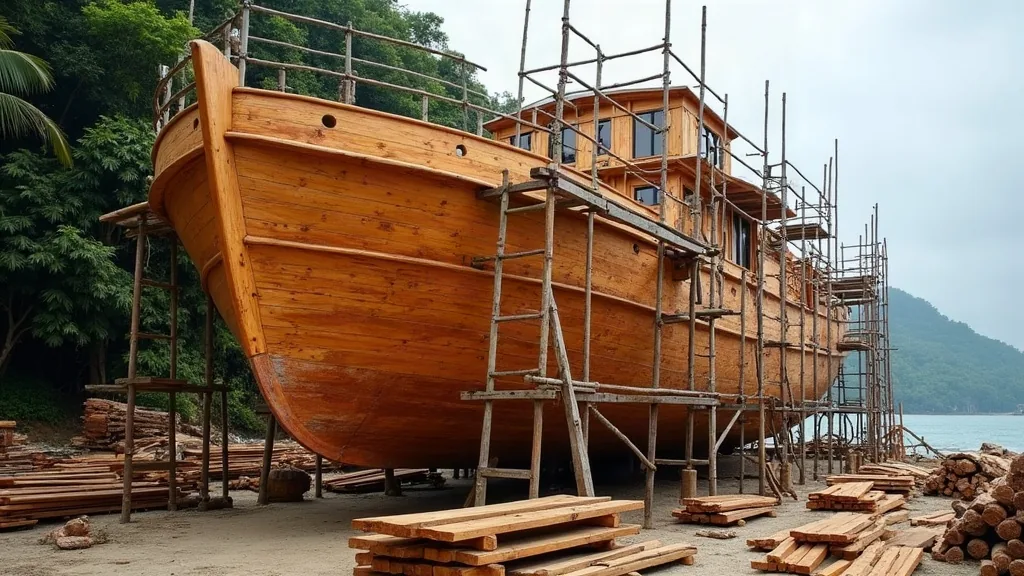
A 30-metre hull is commonly quoted at nine to twelve months. Smaller craft are often cited at ten to fourteen months, and large custom yachts at twenty to twenty-four months or more. That range is not vagueness — it is four specific variables doing their work: timber seasoning, crew allocation, payment rhythm and scope boundary. Three of the four are under an owner’s control.
The range, and why it is honest
| Vessel | Commonly quoted duration | What the figure covers |
|---|---|---|
| 30 m hull | 9–12 months | Keel to launch |
| Smaller craft | 10–14 months | Keel to launch |
| Large custom yacht, full fit-out | 20–24 months or more | Includes substantial interior and systems work |
Note the third column, because it explains most of the apparent contradiction. A smaller vessel can take longer than a larger one when the larger one is a bare hull and the smaller one is a finished yacht. Comparing durations without comparing scope produces nonsense, and it is the single most common error in owner expectations. The stage-by-stage timeline separates the hull programme from the fit-out programme explicitly.
Variable one: timber seasoning
This is the biggest and the least visible. Heavy tropical hardwood must be dry and stable before it is worked, or the hull will move after launch — seams open, fastenings work, and a vessel that looked perfect on the beach starts weeping in its first season.
If seasoned stock of the specified species and dimensions is on hand when you sign, work begins immediately. If it has to be sourced, converted and dried from green, months pass with nothing visible happening. Owners watching an empty patch of sand conclude the yard has not started, and in a sense they are right — but the delay is in the material, not the labour.
What to do: make timber availability an explicit precondition in the contract. State species, quantity, dimensions and seasoning state at signature, and state who carries the cost of waiting if stock is not available. The timber page covers what to specify; the wood question covers why availability is tightening.
Variable two: crew allocation
Crews at Tana Beru are small and frequently work more than one hull. A crew nominally on your vessel may be spending half its week on another. This is not deception — it is how a shoreline of independent operators smooths its own workload — but it directly determines your schedule.
The planking stage is the longest single block of work in the programme, roughly a third of it, and it is the stage where additional hands genuinely compress the calendar. Framing and decking benefit less; caulking and coating benefit not at all, because they are governed by cure times.
What to do: write crew allocation into the contract as a number of workers dedicated to your hull, and inspect against it. It is one of the few schedule levers that actually moves.
Variable three: payment rhythm
Material purchase follows payment here. A late stage payment does not delay the build by the length of the delay — it delays it by the delay plus re-mobilisation, because the crew will have moved onto another hull in the interval and will finish that stage before returning to yours.
The asymmetry is worth internalising: a two-week late payment can easily cost six weeks. Owners who treat payment dates as flexible are, without realising it, buying schedule slip at a poor exchange rate. How stage payments are structured sets out the mechanism, including why paying early against an uninspected milestone is equally unwise in the other direction.
Variable four: scope boundary
Where does the hull contract stop? If machinery installation and interior fit-out happen at Tana Beru, the programme is longer and the beach is occupied. If the hull is launched and delivered elsewhere for fit-out, the Tana Beru programme is shorter but a delivery voyage and a second yard enter the plan — see the delivery voyage.
Neither is wrong. What is wrong is leaving the boundary implicit, then discovering that “nine to twelve months” meant a hull afloat with no engine, no cabins and no certification, four months before your first charter booking.
Weather: the variable you do not control
Structural work continues through the rainy season. Caulking, fairing and coating do not cure properly in sustained wet, so a programme whose final quarter lands in the wettest months will slip regardless of how well it has been managed. Where there is flexibility at the start, it is worth counting forward to check where the coatings phase falls.
How to compress a schedule honestly
- Have seasoned timber at signature. The single largest available saving, and often months.
- Contract dedicated crew numbers and verify them at inspection.
- Pay on time, against inspected milestones. Never early, never late.
- Decide the specification before the keel is laid. Changes after the garboard is on are expensive in time, not just money — see why the shape commits early.
- Split the scope deliberately if the yard’s beach time is your constraint.
- Plan the coatings phase out of the wettest months if the start date allows it.
What does not compress: cure times, seasoning that has not happened yet, and the master shipwright’s judgement. Pressure applied to those produces a hull that arrives on time and fails early.
Plan backwards from revenue, not forwards from the keel
If the vessel must be earning in a particular month, count backwards through certification, sea trials, delivery, fit-out, launch and coatings before you set a keel date. Owners who plan forwards from the keel and treat launch as completion are the ones who discover, two months out, that a floating hull is not a working vessel. Commissioning a build covers how that sequencing belongs in the contract.
Frequently asked questions
How long does a wooden vessel take to build at Tana Beru?
A 30-metre hull is commonly quoted at nine to twelve months from keel to launch, smaller craft at ten to fourteen months, and large custom yachts with full interior fit-out at twenty to twenty-four months or more.
Why can a smaller vessel take longer than a larger one?
Because the figures cover different scopes. A bare hull to launch is a different programme from a finished yacht with machinery, systems and interior. Comparing durations without comparing scope produces meaningless results.
What is the biggest cause of delay?
Timber seasoning. If seasoned stock of the specified species is not available at contract signature, months pass while material is sourced, converted and dried before any visible work begins on the beach.
Does a late payment delay the build by the same amount of time?
No, usually longer. Material purchase follows payment, and a crew that stops work will move to another hull and finish that stage before returning. A two-week late payment can easily cost six weeks.
Can the schedule be compressed?
Partly. Having seasoned timber at signature, contracting dedicated crew numbers and finalising the specification before keel laying all help. Cure times for caulking and coatings, and the quality of the shipwright’s judgement, cannot be compressed.