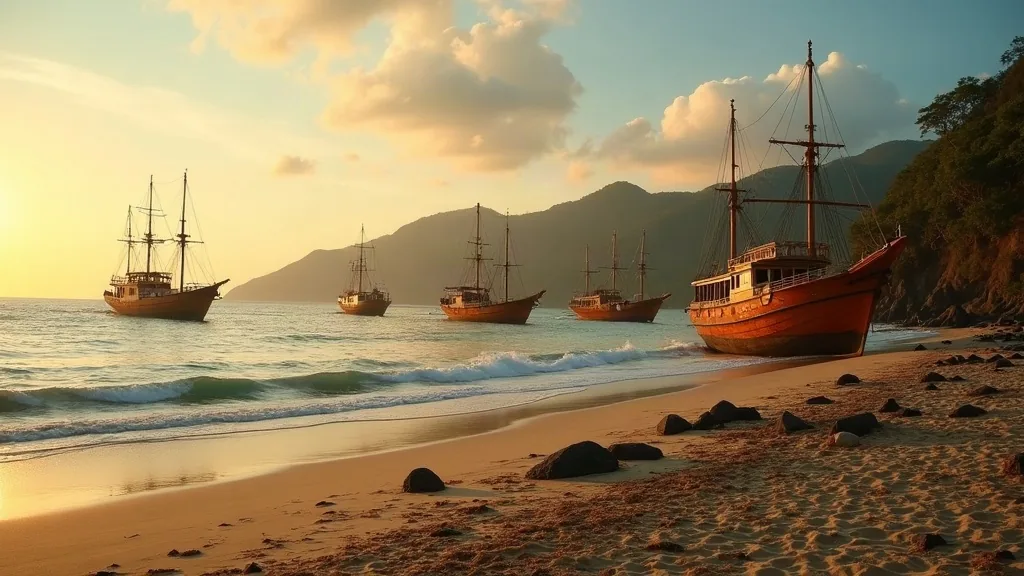
Kabupaten Bulukumba, at the south-eastern tip of South Sulawesi, is known as Butta Panrita Lopi — the land of the master shipwrights. The title is not a tourism slogan bolted on recently; it reflects a concentration of wooden shipbuilding knowledge in a handful of coastal villages in Kecamatan Bonto Bahari, of which Tana Beru is the most visible.
What the name means
Butta is land or territory. Panrita lopi is the master shipwright — the person expert in vessels, whose role is described in the page on the panrita lopi. Together the phrase claims something specific: not that boats are built here, but that this is where the people who know how to build them come from.
That distinction matters, because the knowledge has always travelled further than the timber. Shipwrights from this district have worked on vessels built elsewhere across the archipelago, which is one reason the reputation of Bulukumba exceeds what a visitor counting hulls on one beach would expect.
Where it is concentrated
The shipbuilding villages sit in Kecamatan Bonto Bahari, on the peninsula that ends at Tanjung Bira. Tana Beru carries the largest visible concentration of hulls under construction, which is why it is the village travellers are directed to. Ara has a long-standing reputation for the skill of its shipwrights. Bira, at the tip, is better known now for its beach, its ferry port and its accommodation — the comparison of the three villages sets out what each is actually for today.
Bulukumba town itself, some 25 km north-west of Tana Beru, is the administrative centre rather than a building site. Visitors arriving expecting shipyards in the town will not find them.
Why here, and not somewhere else
Several things had to coincide. A coastline with beaches shallow and firm enough to build on and launch from. Access to heavy tropical hardwood in the sizes a hull requires. A maritime economy that generated continuous demand for vessels. And, critically, a social structure that transmitted the knowledge — apprenticeship within families and communities, over generations, in a form that could not be written down because it was never written down.
That last condition is the fragile one. Timber can be transported and beaches exist elsewhere, but a body of embodied knowledge cannot be relocated or reconstituted. It survives by being practised, which is the argument running through the apprenticeship gap.
The trade the reputation was built on
The vessels that made this coast’s name were working craft: sailing cargo carriers moving goods between islands across the archipelago. That is the trade the hull form comes from, and understanding it explains a great deal about the vessels visitors see today — the volume, the sheer, the way the hull is arranged for load rather than for guests.
Today most hulls leaving Tana Beru are motorised and fitted out for passengers rather than cargo. That is a genuine change in the type’s purpose, and it is also what has kept the yards working. Three business cases for one hull sets out how the same construction now serves very different economics.
What the title means today
Three things, honestly stated.
It is a real historical description. The concentration of skill in these villages is not invented, and the vessels are evidence. Anyone who walks the shoreline and looks at a fair hull built without drawings can see it.
It is also a working economy under pressure. The constraints are material and demographic: hardwood in the required dimensions is harder and more expensive to obtain, as set out in the wood question, and fewer young people are entering a trade that takes decades to master and pays less than alternatives.
And it is increasingly a heritage designation. The art of pinisi shipbuilding was inscribed on the UNESCO Representative List of the Intangible Cultural Heritage of Humanity in 2017 — recognition that belongs to the craft and its community rather than to any yard or business. What that changed on the ground, and what it did not, is examined in the piece on the inscription.
Visiting the district with the title in mind
The most useful thing a visitor can do with this context is look for the transmission rather than only the vessels. Watch who is doing which work. Notice whether older and younger people are working the same hull, and whether anyone appears to be learning rather than only labouring. That observation tells you more about whether Butta Panrita Lopi describes a present or a past than any number of photographs of timber.
Practical guidance for the visit is in the visiting guide, and a morning walking route sets out where to look and what each stage means.
Hearing the phrase on the ground
Visitors meet Butta Panrita Lopi before anyone explains it: on regency signboards and gateways, in the names of local events and businesses, and in conversation the moment you tell someone in Bulukumba why you have come. It functions less as a slogan than as shorthand for a claim the district expects you to test — go to the shoreline and look. Asking about the phrase is also one of the easiest ways to open a conversation at the yard, because it invites people to talk about the trade in general rather than about their own contract, which crews are understandably more guarded about. If you ask one question, ask who taught the person you are talking to. The answer — a father, an uncle, a neighbour — is the title working exactly as it always has.
Frequently asked questions
What does Butta Panrita Lopi mean?
Land of the master shipwrights. Butta means land or territory, and panrita lopi is the master shipwright — the person expert in vessels. It is the honorific by which Kabupaten Bulukumba is known.
Which villages does the title refer to?
The shipbuilding villages of Kecamatan Bonto Bahari on the peninsula ending at Tanjung Bira. Tana Beru has the largest visible concentration of hulls under construction, and Ara carries a long-standing reputation for the skill of its shipwrights.
Are there shipyards in Bulukumba town?
No. Bulukumba town, around 25 km north-west of Tana Beru, is the administrative centre. Visitors expecting to find shipbuilding in the town itself will not find it.
Why did wooden shipbuilding concentrate here?
A coastline suitable for building and launching, access to heavy tropical hardwood in the required sizes, a maritime economy generating continuous demand for vessels, and a social structure that transmitted the knowledge through apprenticeship over generations.
Is the title still accurate today?
It describes a real concentration of skill, but one under pressure. Hardwood in the required dimensions is harder and more expensive to obtain, and fewer young people are entering a trade that takes decades to master.